
The first spring Biscuit lived here, I vacuumed the living room carpet on a Saturday morning. By Sunday afternoon the hair was back, thick enough that Glen asked whether the vacuum was actually pulling anything up. It was. The dog simply sheds faster than anyone warned us.
Biscuit is 7 now, mostly beagle, about 30 pounds, and the county shelter described him as a short-haired dog. Whoever typed that had never met him. I tried a slicker brush first, which skated over the top coat, then a rubber curry, which lifted some hair and a fair amount of dander and left the rest exactly where it was. What was causing the carpet problem was the loose fluff packed underneath. So last spring I bought the Maxpower Planet Dog Grooming Rake. The review count was the deciding factor, honestly. Sixty thousand people cannot all be wrong about a hair tool.
The Quick Verdict
Two sides, one for mats and one for the everyday undercoat, and it pulls loose hair better than anything else in my grooming basket. It does not clear itself, and it will not keep the couch clean for you.
Amazon Check Today's Price →The rake that pulls the undercoat out instead of pushing it around
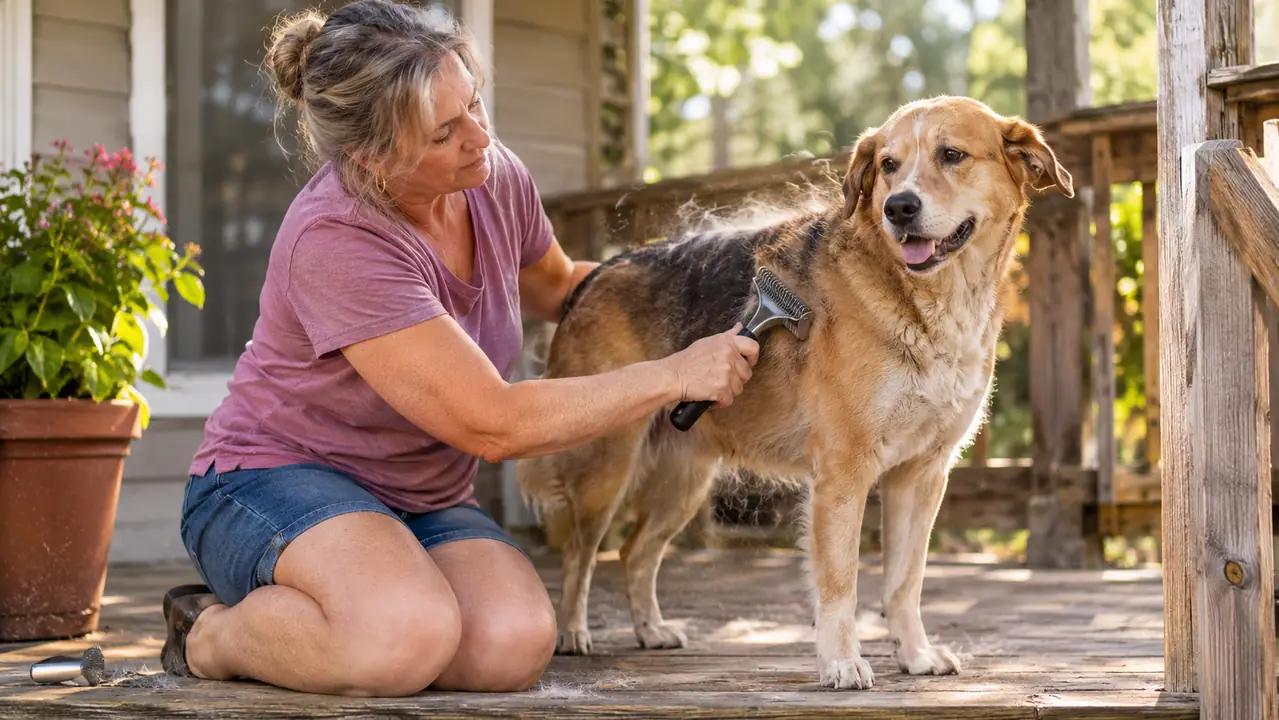
A narrow 9-teeth side for mats and a wider 17-teeth side for the regular shed, with a rubber handle that stays put in a damp hand. This is what I use on Biscuit twice a week on the porch.
Amazon Check Today's Price on Amazon →How I've Used It
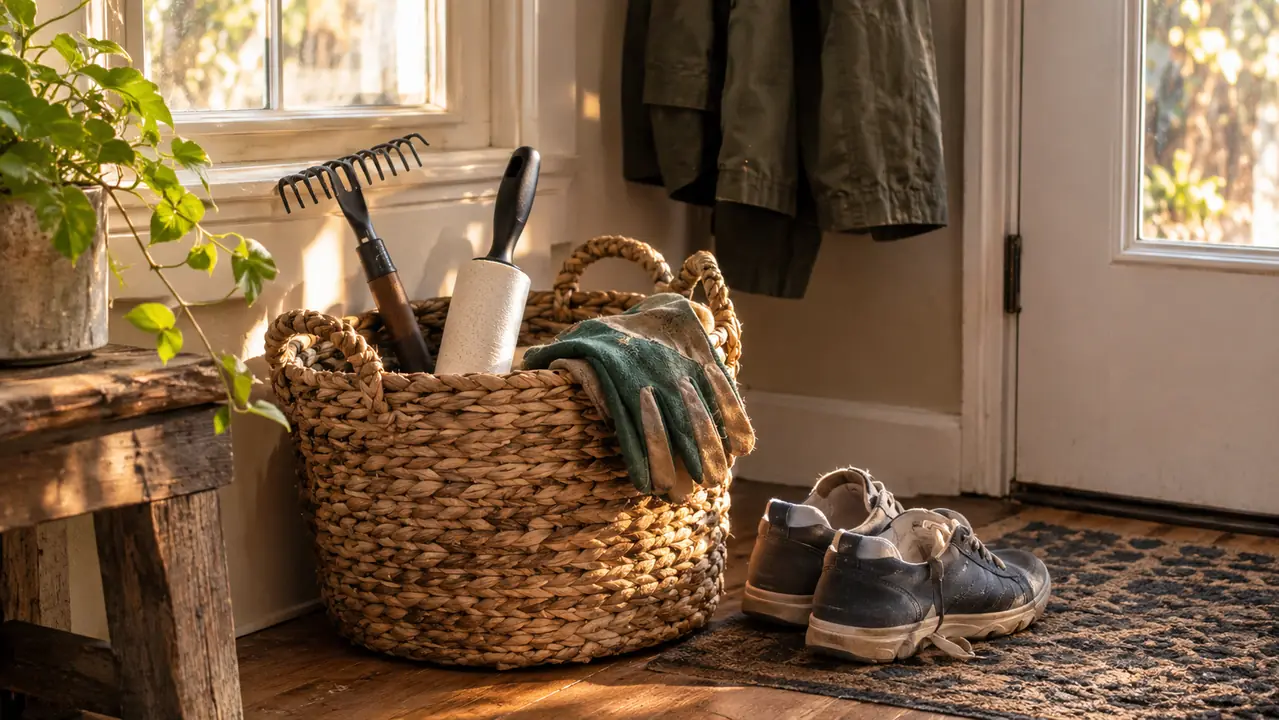
The rake lives in a basket by the back door with a pair of garden gloves and a lint roller I keep forgetting to carry inside. Twice a week, weather permitting, Biscuit and I go out on the back porch and I sit on the step while he stands there and sighs at me. Ten to fifteen minutes, usually. If his skin looks pink or he starts shifting his weight away, we stop early and pick it up the next day.
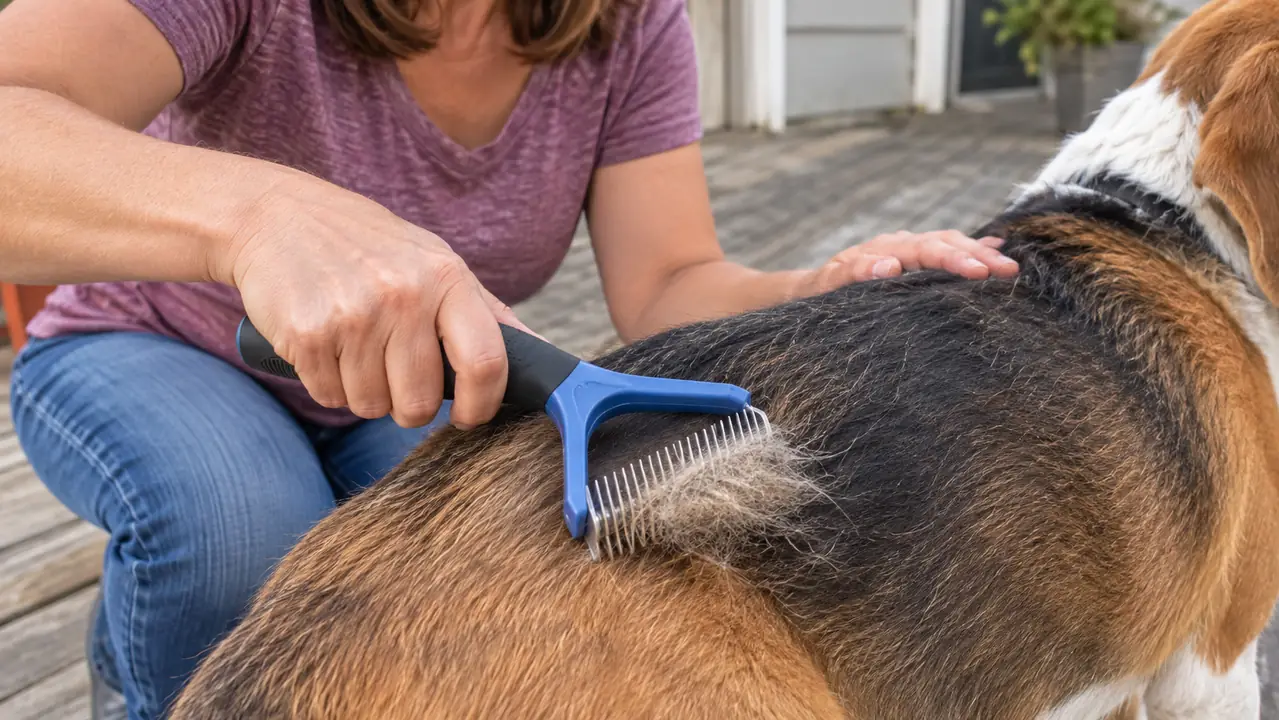
The motion is not complicated. I lay the teeth against his coat at a slight angle and draw back with the lie of the hair, in short strokes of maybe six inches. No pressing. The first time I used it I pushed harder than I needed to because not much seemed to be coming up, and I learned quickly that pressure is not what makes this work. Depth is. You want the teeth down to the skin and the hand light.
Where I start depends on the season. In spring and early summer, when he is blowing coat, I begin with the wide side along his back and flanks and work my way down. Later in the summer, when the shedding settles but the mats do not, I start behind his ears with the narrow side and follow up with the wider one. Either way, the back porch is the right place for it, not the living room. More on that below.
That first session is worth describing because I got it wrong. I took him out on a warm Saturday in April, sat on the step and started on his back with the wide side, pressing. Nothing much came up for the first minute and I decided the tool was overrated. Then I caught the angle properly, teeth down to the skin and hand light, and the coat started letting go in soft clumps. I kept going for twenty minutes because I could not quite believe how much was in there. That was too long. He got fidgety, I got a sore forearm, and the short twice-a-week rhythm we have now came directly out of that first attempt being too much of a good thing.
When it rains for three days straight, we skip. By the end of a week like that the carpet near the stairs tells on us, which is its own kind of reminder that the porch sessions are doing real work.
The Two Sides, and When I Actually Switch
The 9-teeth side is the narrow one. The teeth sit further apart and are set up to work through mats and tangles rather than coat, which makes it the side I reach for behind Biscuit's ears, under his collar line and around the base of his tail. That is where his fur knots into small pellets that a regular brush just rides over. A few careful passes with the narrow side breaks those up, and then the wider side has something to work with.
There is one mat I remember specifically, a small hard knot behind his left ear that had been there long enough that I had stopped seeing it. The slicker brush went over it every session without ever touching it. The narrow side took three short passes, working at the outside of the knot and easing inward rather than digging at the middle, and it came apart into a tuft I pulled out with my fingers. That is the pattern with this side. You chip at the edges of a mat instead of trying to drag the whole thing out at once, and the whole job costs you about ninety seconds.
The 17-teeth side is the workhorse. More teeth, closer together, and it is what actually hauls the loose undercoat out. On a heavy shed day I can do his whole back and both flanks in about ten minutes and end up with a pile of hair the size of my fist. The teeth are stainless steel and the tips are rounded, which matters more than I expected. I have used cheap rakes where the tips were sharp enough to leave pink lines on a dog's flank. This one has not done that, and I have been careless once or twice.
The Maxpower Planet rake has a rubber handle and weighs about 4 ounces, so my wrist is not complaining by the end of a session. It measures roughly 6.6 by 3.9 by 2 inches, which makes it small enough to sit in the basket without taking it over, and the oblong head fits the curve of a shoulder reasonably well. It is not a delicate tool. It is a hair tool that happens to be shaped comfortably.
What Seven Months of This Did to the Hair in This House
The carpet is the honest measure. Before the rake, I vacuumed the living room and the stairs twice a week and the canister came out full of fluff both times. Now I vacuum once a week and the canister is maybe half as full, and the difference is not the vacuum. It is that a good portion of that hair comes off the dog on the porch instead of drifting into the house.
The stairs are where I notice it most. Carpeted stairs plus a dog who sleeps at the top of them used to mean a visible haze on every tread by Thursday. That build-up has not disappeared, but it takes closer to two weeks now, and when I run the vacuum up them it comes clean in one pass instead of two.
I have a rough way of keeping score, and it is the vacuum canister. The week before I started raking regularly, I emptied it after doing the living room and the stairs and it was full to the line. The same two rooms in late September, after a summer of twice-weekly sessions, came out at maybe a third of that. September is not May and I am not going to pretend those two weeks are a fair comparison, but the trend held across the whole summer and into the fall, which is longer than any brush I have owned has managed to stay useful.
There is a cost to that, and the cost is a slightly odd-looking porch. The first few sessions produced so much hair that I stood there looking at it, wondering whether I had hurt him. He was fine. He was wagging. It is just that a dog carrying that much loose undercoat has a lot to give, and a rake is far more efficient at taking it than anything I had used before.
Where It Annoyed Me
The hair does not go anywhere on its own. There is no button, no ejector, no tray. When the teeth load up, which on a heavy shed day is roughly every two minutes, you stop and pull the mat of hair off with your fingers. I keep a paper bag beside me on the porch for exactly this. It is a small thing and it gets old, especially when the mat is damp. If a tool exists that solves this on a rake this size, I have not owned it.
The second annoyance is that it only does one job. It does not smooth a top coat the way a bristle brush does, and it will not make a dog look freshly groomed after a session. It removes loose undercoat and it breaks up mats. If appearance is the point, you finish with something else.
The third is that it is easy to overdo. Because it works, and because hair keeps coming, it is tempting to keep going until nothing else lifts. Biscuit's coat along his lower back went a little thin in the first month before I learned to stop while there was still coat to rake. Twice a week, ten to fifteen minutes, is the rhythm that works here. More than that and you are wearing out the tool and the dog.
One more small thing, and then I will stop complaining. Loose undercoat sticks to the rubber handle, and after a few sessions the grip looks like it has grown a coat of its own. It wipes off with a damp cloth and it changes nothing about how the tool works, but it makes the thing look older than it is. The oblong head is also a fixed width, so on the narrow parts of a dog, the legs, the space between the ears, you are working with a tool wider than the area you are trying to reach. I use the corner of the head for those spots and accept the awkwardness.
Juniper, and the Short Version of Cat Grooming
Juniper is our 4-year-old tabby, indoor only, about 10 pounds, and she is not a shedding problem the way Biscuit is. But she gets a little scruffy along her back in the spring, so I tried the rake on her a handful of times, gently, with the wide side and one hand flat on her shoulders. She will tolerate maybe two minutes before she stands up and leaves with her tail in the air, which is her way of filing a complaint.
Two minutes is enough to make a difference on a cat her size, and I do not push past the point where she walks. If you have a cat who hates being handled, this is not the tool that will change her mind. It is just a rake. But if your cat already sits still for a brush, the narrow side will lift a surprising amount of winter coat in a couple of passes.
What I Liked
- Two sides that do different jobs, a 9-teeth side for mats and a 17-teeth side for the everyday shed
- Rounded stainless steel tips have not scratched Biscuit, even when I pressed harder than I should have
- About 4 ounces with a rubber handle, so fifteen minutes of raking does not wreck my wrist
- Cut the visible hair on the carpet and stairs by roughly half once we settled into twice-weekly sessions
- Seven months of porch use and I cannot find a bent tooth
Where It Falls Short
- No way to clear the teeth except pulling the hair off with your fingers, which you do a lot
- Does one job. You still need something else to finish a top coat
- Easy to over-rake one spot if you keep going until nothing lifts
- Not something a cat who dislikes handling will accept, in my experience
Ten minutes with the wide side took more loose hair off that dog than a month of slicker brushing, and it was all sitting on the porch instead of in the carpet.
Who This Is For
If you have a dog who sheds more than the breed chart promised, and you are tired of watching hair settle into carpet and upholstery a day after you vacuum, this is the tool I would hand you first. It suits short and medium coats with a real undercoat underneath, which is exactly the shape of Biscuit's coat. The Maxpower Planet rake also suits anyone who wants one grooming tool rather than a basket full of them, because this plus a bristle brush covers what a normal dog needs.
It suits a household where the shedding problem is in the carpet rather than on a hard floor. Raking a dog on a porch or in a garage before he comes inside is a different job than brushing him in the living room and watching the hair float. The rake makes the outside version worth doing, and the outside version is the one that keeps the house cleaner.
Who Should Skip It
If your dog has no undercoat to speak of, a single-coated coat with fine hair close to the skin, there is not much here for the teeth to catch. You will drag it over the dog, get a little surface hair, and wonder what the fuss was about. A rubber curry or a soft bristle brush is the better fit for that coat.
Skip it too if your dog will not hold still for ten minutes of handling, or has skin that is already raw or broken, or has a coat matted all the way down to the skin. That last one is not a rake job. That is a clipper and possibly a groomer, and dragging a rake through a solid mat is a good way to hurt a dog and lose his trust in the tool at the same time.
Seven months in, it is still the first thing I reach for when the stairs start going fuzzy
The Maxpower Planet grooming rake. Twice a week on the porch, ten to fifteen minutes, and the vacuum canister tells the rest of the story.
Amazon Check Today's Price on Amazon →