
For three springs in a row I vacuumed our carpeted stairs twice a week and still met a fresh grey layer of beagle-mix hair every single morning. Biscuit is seven, about thirty pounds, and sheds like a dog twice his size. Last spring I bought a Maxpower Planet grooming rake. A neighbor had already handed me a slicker brush she no longer wanted. Seven months of using both on the same dog, in the same house, on the same carpet, taught me one thing: they are not competing for the same job, and once you understand that, the decision stops being hard.
Here is the short answer. A rake gets under the topcoat and pulls out the loose undercoat that is already on its way to your floor. A slicker brush works the surface, lifts light tangles, and is the right tool for faces, ears, paws and thin coats. If your dog sheds heavily, the rake does the heavy work and the slicker tidies up afterward. If your dog barely sheds, or you have a short-haired cat, the slicker is likely all you need.
| Maxpower Planet grooming rake | Slicker brush | |
|---|---|---|
| Loose undercoat on a heavy shedder | The 17-teeth side rakes under the topcoat and pulls out hair that was already loose | Pins ride the surface and lift very little of the undercoat |
| Mats and knots | The 9-teeth side works at a mat in short strokes without dragging the skin under it | Pins snag on a mat and pull straight down instead of working through it |
| Face, ears, paws and thin patches | Teeth are too much for a muzzle or a thin-skinned spot | Fine pins are made for small, careful areas |
| Short single coat, like my tabby's | Barely catches anything on a short coat | Lifts the loose surface hair and leaves the coat smooth |
| Older or sensitive skin | Stainless teeth need a light hand and short sessions | A soft pin pad is easier to keep gentle |
| Clearing the tool afterward | Hair gathers between the two rows of teeth and lifts out in one clump | Hair weaves into the pin pad and takes a minute with a comb |
| Long sessions on a big dog | Rubber handle and four ounces stay comfortable for fifteen minutes | Light handle, but the pad loads up and needs clearing mid-session |
| Best for | Double-coated shedders and a spring coat blowout | Finishing, faces, and light-shedding pets |
Where Maxpower Planet Wins
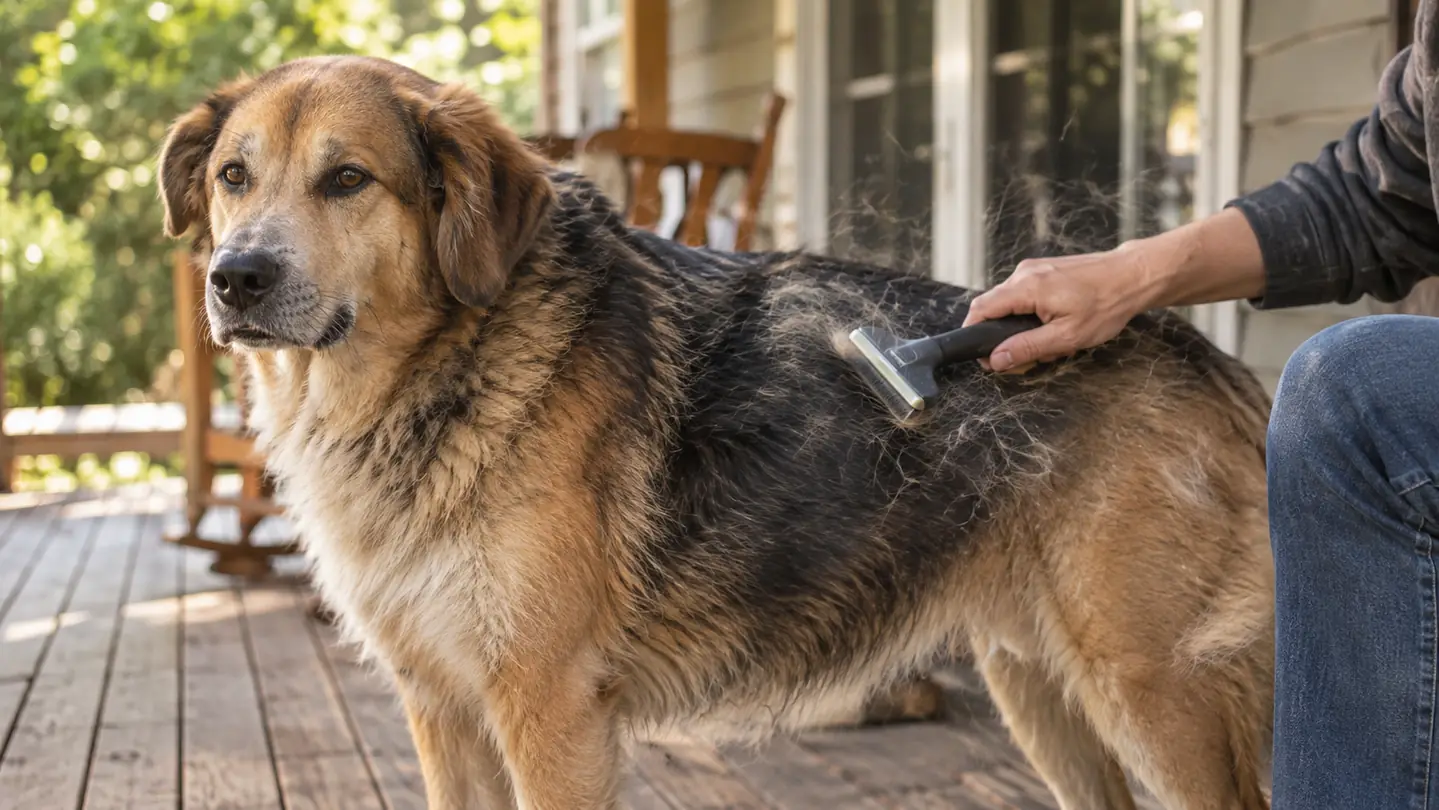
The rake wins on volume. That sounds like a small thing until you watch it happen. Biscuit stands on the back porch, I start with the 17-teeth side along his back and down his flanks in short overlapping strokes, and hair that I could not see in his coat starts coming up onto the teeth. Not a dusting of hair. Actual clumps. Ten to fifteen minutes twice a week and the porch boards look like a bird got into a fight out there. That hair was already loose and it was going to end up on the stairs and the living room carpet. The rake just moved the appointment forward, onto the porch, where I could sweep it up with a dustpan instead of pulling out the vacuum. Before the rake I spent a month using only the slicker, twice a week, on the theory that any brush was better than none. It was not nothing. It took the dust off his back. But the stairs were still grey every morning, and the canister on the vacuum filled at exactly the same rate. The difference when I switched came down to what the tool was reaching, not how hard I was working at it.
It also wins on the tangled stuff, which I did not expect. The 9-teeth side is the coarse side, and it handles a mat differently than pins do. Pins go straight down into a knot and stop, and the pressure ends up on the skin underneath. The wider teeth get under the edge of the mat and let you work it apart from the outside in. Biscuit gets small mats behind his front legs where his harness rubs, and I have cleared every one of them with the 9-teeth side, working a little at a time over a couple of sessions rather than fighting it in one go. He stands still for it, which is the only review that matters. The teeth are sharpened but rounded, so I can work close to the skin without bracing for a yelp.
Where a Slicker Brush Wins
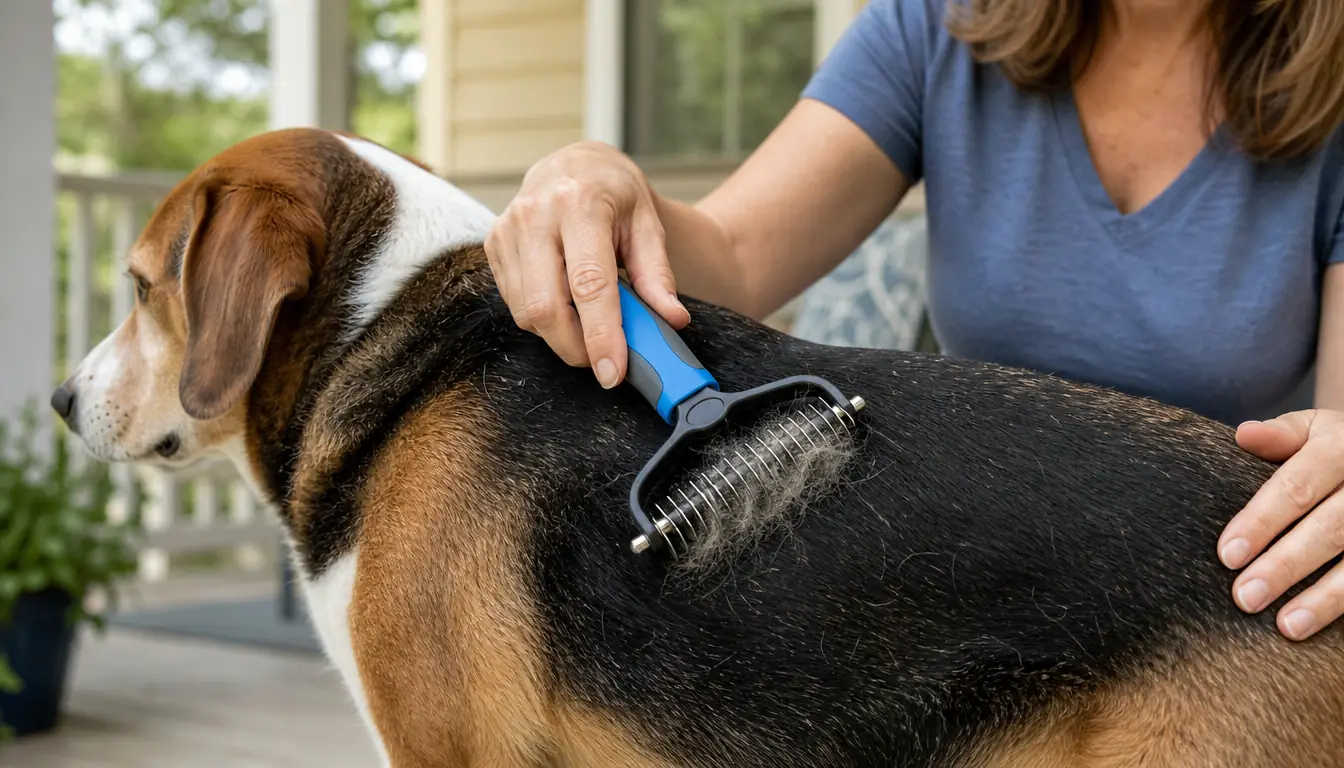
The slicker brush wins everywhere the coat is thin and the skin is close to the surface. Biscuit's muzzle, the tops of his ears, the backs of his legs and the bony part of his hips do not want a steel-toothed rake anywhere near them, and I would not use one there. The fine pins on a slicker are light enough to sweep over those places and pick up the surface hair without the dog flinching. It is also the tool I reach for after the rake on a normal session. The rake pulls the dead undercoat out and leaves the coat looking roughed up and uneven. Two or three minutes with the slicker smooths the topcoat back down and he looks like a dog again instead of a partially plucked one.
And on Juniper, the slicker wins outright by a mile. She is a four-year-old short-haired tabby, ten pounds, indoor only, and the boss of this house. I tried the rake on her a few times last spring because she was shedding on the couch. She tolerated about ninety seconds of it and then walked off with her tail up, and honestly the rake barely caught anything on that short coat anyway. The teeth are spaced for a coat with some depth to it. A slicker passes over her back and sides, lifts the loose hair that was going to land on Glen's recliner, and she stays put for it. That is the whole story for a short-haired cat.
If your dog sheds like mine, this is the tool that fills the porch with hair instead of the carpet
The Maxpower Planet rake has a 17-teeth side for everyday undercoat work and a 9-teeth side for mats behind the legs and under the harness. It has been in the basket by my back door for seven months and it is the first thing I grab when the coat starts blowing.
Amazon Check Today's Price on Amazon →How I Use Both in One Sitting
The order matters more than the tools. I start with the rake on a dry coat, never after a bath, because wet hair clumps and the teeth drag instead of gliding. Seventeen-teeth side first, going with the grain down his back and along his sides in short strokes, lifting the tool rather than raking it like a garden bed. I clear the teeth into a paper bag every few passes, because once they load up the tool stops catching anything and I am just petting him with metal. Ten to fifteen minutes, twice a week, is what has worked. If I stretch it to twenty he gets bored and starts trying to lie down on the tool, and a lying-down dog is not a groomed dog. I learned the dry-coat rule the hard way. One Sunday I bathed him first, thinking clean hair would come out easier, and the tool dragged and skipped and pulled at his skin until he walked to the far end of the porch and stood there looking at me. Now he gets brushed first and bathed second, which means the bath water is not carrying a pound of loose hair down the drain either.
Then I switch to the 9-teeth side only on the matted spots, which for Biscuit means behind the front legs and along the strap line where his harness sits. Short strokes at the edge of the mat, not into the middle of it. Then I finish with the slicker over his face, ears, legs and hips, plus a quick pass over his whole body to lay the topcoat flat. All told it is maybe twenty minutes on a Sunday and ten on a Wednesday. The rest of the week I do nothing beyond a quick hand pass, and the stairs stay clear. That is a pace I can keep up with, which is the only grooming schedule that survives contact with a real week.
Ten minutes with the rake on a Sunday and the porch boards were grey with hair. Three minutes with the slicker afterward and Biscuit looked like a different dog. Both, or neither works right.
Cleanup is where the two tools split again. The rake pulls hair out in one clump between the two rows of teeth, so I can lift it off in a single piece and drop it in the bag. The slicker weaves hair into the pin pad and I end up digging it out with a metal comb, which takes about a minute and which I almost never feel like doing. That minute is the reason the slicker lives in a drawer and the rake lives by the door in the basket where I can reach it without thinking. The tool you reach for is the tool that works. The one in the drawer is a nice idea.
What Neither Tool Fixes
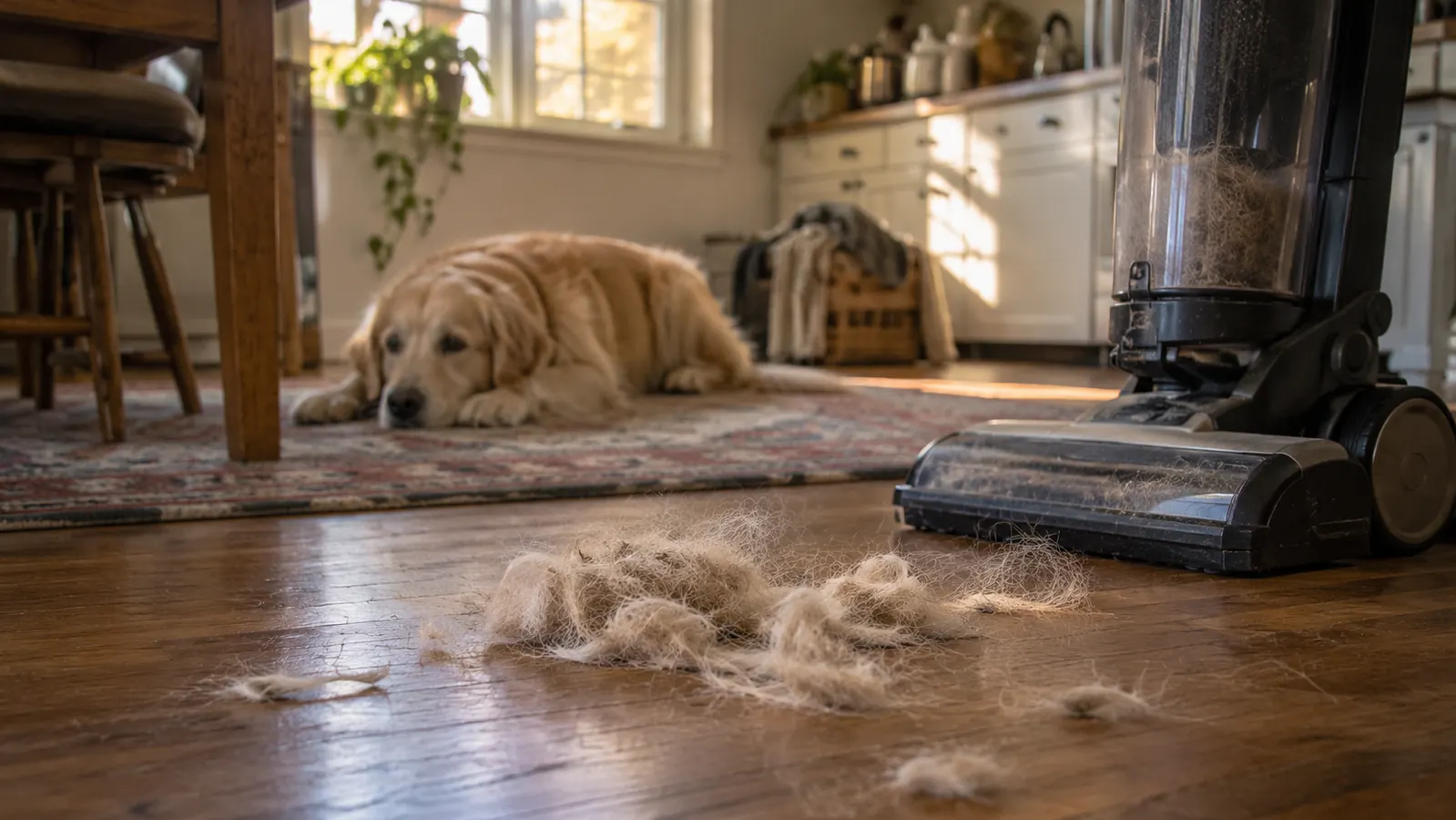
Neither one stops the shedding, and I want to be plain about that because a lot of writing on this subject is not. Biscuit still drops hair on the carpet. The difference is volume. Before the rake, I was emptying the vacuum canister twice for every pass over the stairs. Now it is closer to every third pass, and the couch cushions need the roller less often than they used to. The cat hair on Glen's recliner is a separate problem with a separate solution, and no brush on earth was going to fix it. Brushing moves the loose hair from the furniture to a paper bag. That is the whole benefit, and it is a big enough benefit that I keep doing it. I keep a cheap kitchen scale in the laundry room for reasons that have nothing to do with dogs, and out of curiosity I weighed the bag after one Sunday session. Half a pound of hair off a thirty-pound dog who did not look any thinner afterward. It was not a full bag. It was a lump about the size of my hand, and it had been sitting on my stairs ten minutes earlier.
It also does not replace a vet visit if your dog is itching, licking a spot raw, or losing coat in patches. I am not a vet and I am not going to play one here. What I can tell you is what a rake and a slicker did on a healthy seven-year-old dog with a normal spring shed and a handful of harness mats. If something on your dog looks angry or bald, put the tools down and make a phone call.
The Coat Types That Change the Answer
If your dog has a double coat, meaning a soft undercoat under a coarser topcoat, the rake is the tool that earns its keep. That undercoat is the part that comes out in handfuls, and it is the part a slicker cannot reach. If your dog has a short single coat, a slicker or even a rubber curry does everything you need. If your dog has a long silky coat, the answer changes again and you are probably looking at a comb as your main tool, with a slicker for finishing. And if your dog's coat is curly and dense, neither of these is the answer on its own. A woman down the road asked me last fall what to buy for a dog with a coat like a bath mat. I told her the rake would pull at it, the slicker would ride on top of it, and neither would do the job alone, and that she should talk to a groomer about a comb and a routine before she spent money on either. That is the case where the answer is a phone call, not a purchase. This is why the question has two honest answers instead of one.
Who Should Buy Which
Buy the Maxpower Planet rake if you have a double-coated dog that leaves hair on the floor, if spring turns your carpet into a second dog, if your dog gets harness mats behind the front legs, or if you have accepted that you are going to groom at home rather than pay someone. It is four ounces with a rubber handle, it has two sides, and it fits in a basket by the door. Buy a slicker brush instead if your pet has a short coat, if you have a cat like Juniper, if your dog is small and thin-skinned, or if you want a finishing tool for faces and paws. Buy both if your dog sheds heavily and also has a face, which is most dogs. If I had to keep only one, it would be the rake, because the rake is the one that keeps the stairs clear. But I would miss the other one by Thursday.
Start with the side that clears the undercoat, finish with the side that handles the mats
One tool, two tooth counts, seven months of Sunday mornings on my back porch. If your dog's coat is already on the carpet, the rake is where I would spend the money first.
Amazon Check Today's Price on Amazon →