
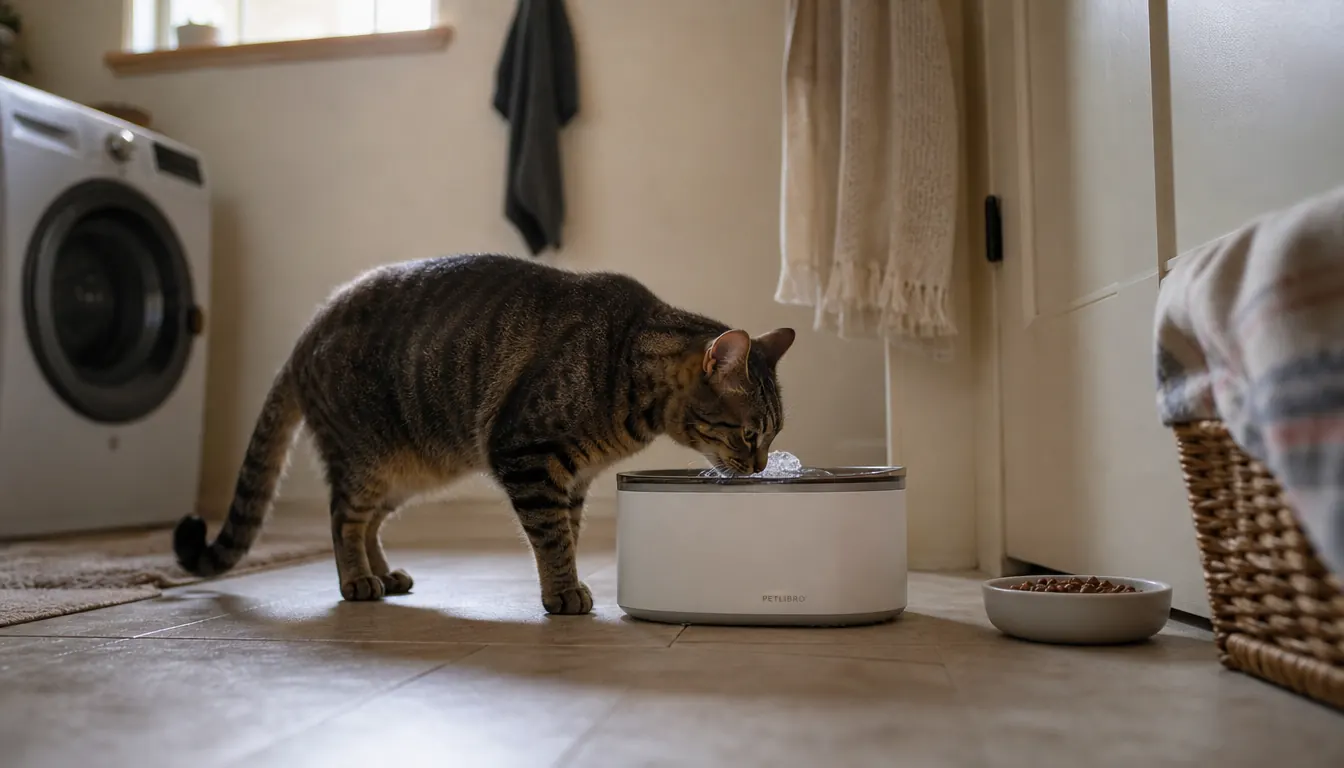
Juniper would only drink from the bathroom sink. Not from a bowl, not from a mug, not from the ceramic dish I bought her thinking it was nicer than the plastic one. The sink, with the tap running at a thin trickle, and she would sit up on the counter and wait for somebody to walk past and turn it on for her.
For a few months there, Glen and I took turns being that somebody. You do not realize how often you walk past a bathroom until a ten pound tabby has trained you to stop at it. So early this year I brought home the Veken 95oz fountain and set it in the laundry room beside her food, and she drank out of it the first afternoon. What I did not know then is that a fountain is not a bowl. A bowl you rinse and forget. Something that runs a pump and pushes water through a filter every hour of the day needs a schedule, and if you skip the schedule it tells you by getting loud, and then it tells you by quitting.
She ignored every bowl in this house and drank from this one on day one
The Veken 95oz C1 holds about 2.8 liters and runs two flow styles, a flower waterfall and a gentler well. Ours has been running in the laundry room for most of this year. If your cat is a tap drinker, start here.
Amazon Check Today's Price on Amazon →Step 1: Unplug It and Take the Whole Thing Apart Once a Week
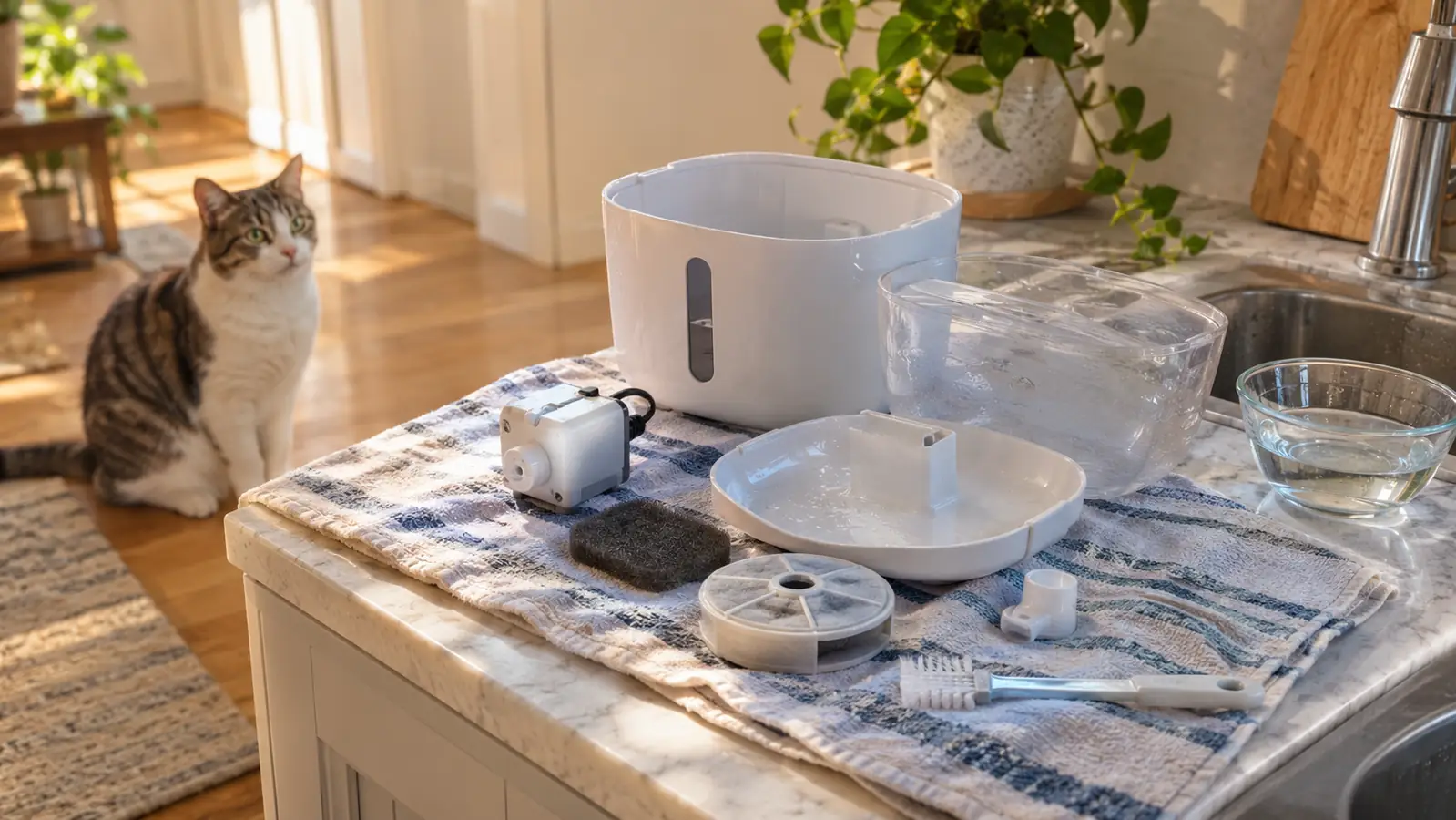
Sunday morning is my time for it, mostly because the laundry room is where the laundry already happens and I am standing there anyway. I unplug the pump at the wall, lift the lid off the base, pull the spout, lift out the water level window piece, and set the pump aside for later. Everything goes on a dish towel by the sink. From unplug to towel is about a minute, and that minute is the difference between a fountain you keep and a fountain you resent.
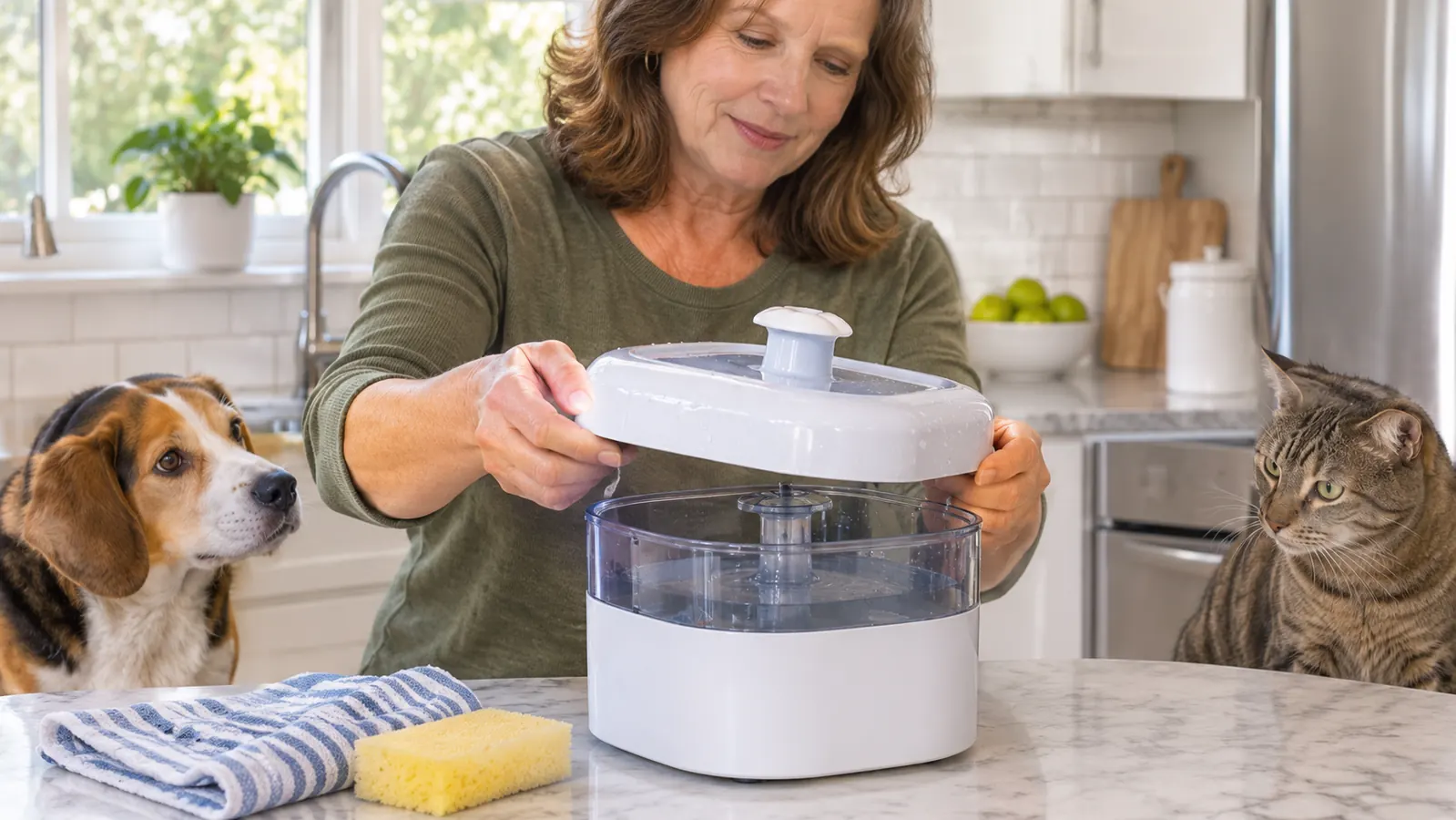
The first time I broke it down I was surprised by the film on the underside of the lid. Not slime exactly, more of a slick. Moving water leaves a residue on every surface it touches, and if your cat is a crumb dropper like Juniper, or if your water is hard like ours, it builds up faster than you would guess. Warm water and a soft sponge take most of it. I use one drop of plain dish soap on the base and the lid, then rinse twice, because I do not want soap going back into the water she drinks.
Do not skip the water level window. It is a small piece with a float in it, and if it never comes out, a haze builds behind the plastic and the level gets hard to read. Mine pops out, gets a rinse and a wipe, and goes back in. There is also a blue LED in the base that shines up through the water, and a film over that spot dims the whole fountain, so I wipe it while I am in there.
Step 2: Clean the Pump, Because the Pump Is What Quits First
The pump sits in a well in the bottom of the Veken base and comes out with a gentle pull once the cord is free. There is a small cover over the impeller that pops off. Underneath is a little plastic fan on a magnet, and that fan is where every problem I have had with this fountain started. Cat fuzz, hair, a film of mineral grit. It does not take much to slow an impeller down, and a slow impeller is a loud fountain.
I rinse the pump body under running water, then take an old toothbrush to the impeller and the cavity it sits in. No soap inside the pump, ever. I have never put any of these parts in the dishwasher and I would not, because the heat is unkind to thin plastic and to the pump seal. Warm water, a brush, and a good rinse is the whole job, and it takes about five minutes.
Ten months in, the pump on mine is still the original one. The only times it has gotten noisy, it was a dirty impeller, both times, and both times a five minute cleaning fixed it. That is not luck. It is the one maintenance task on this fountain I would not skip even if I skipped all the others.
Step 3: Descale With White Vinegar When You See White Crust
Tulsa water is hard enough that I notice it on the shower head, so I notice it on fountain parts too. The first sign is a chalky white line at the water line inside the base, and a rough feel on the pump cover. That is mineral scale, and a sponge will not take it off no matter how hard you scrub.
My routine is a splash of plain white vinegar in a cereal bowl, warm water to cover, and the pump cover and small parts go in for fifteen or twenty minutes. Then a soft brush and a rinse. Everything comes out smooth again. I do the inside of the base with a vinegar dampened cloth and rinse it well afterward, because a vinegar smell in the water will put Juniper off her fountain for a day.
I do this about once a month, more often in the summer when the house is dry and she drinks more. If your water is softer than ours you may only need it every other month. If you let the scale go, it does not just look bad. It starts shedding into the water and clogging the impeller, which puts you right back at Step 2 with a rattling pump.
Step 4: Put It Back Together in Order and Pick the Flow You Want
The fountain has two flow designs. One is a flower waterfall that spills off the top edge like a tap, and the other is a gentler fountain that wells up instead of spilling. Juniper came to this from a bathroom faucet, so the waterfall was the setting that got her drinking on day one, and it is the one we have stayed on. If your cat is nervous about moving water, start on the gentler one and give it a week.
Pump back in its well first, then the water level window, then the spout, then the lid. Fill the base with water before you plug anything in. Running a pump dry is the fastest way to ruin it, and it does not take long. Once it is full, plug it back in and watch for a minute. If it burps or spits, there is air in the pump, so top it off and give it a little time.
The switch is on the cord rather than on the body of the fountain, which I did not expect the first time. It is handy once you know where to reach, because you can shut the whole thing off without crouching down and pulling the plug every week. The cord is six feet, which reached the outlet above our laundry counter, and this is a corded unit, so plan on an outlet rather than a corner.
Step 5: Stay Ahead of the Filter and the Water Level Between Cleanings
The Veken runs a five stage filtration system, and the listing says to clean the pump and replace the filter every one to two weeks. I will be straight with you, I do not change mine every week. I rinse the fountain weekly and swap the filter roughly once a month, and I have done that since early this year without a problem I could point to. If Juniper were a heavier drinker, or if we had two cats, I would move closer to the packaging schedule.
The filter matters more than it sounds like it does. It is catching hair and grit before any of it reaches the impeller, so a worn out filter makes the pump work harder, and a pump working harder is a pump you can hear from the hallway. Buying them in a multi pack and keeping them in the cabinet next to the fountain is the only reason I stay anywhere near a schedule.
Water level is the other thing to check between deep cleanings. The 95 ounce base, about 2.8 liters, lasts Juniper around four days in cool weather and closer to two when the heat is running and the house is dry. The water level window on the front and the blue light make it a glance as you walk past, which matters, because a fountain that runs low gets loud and then gets hot. I top it off every other morning from a pitcher I keep on the counter. It takes less time than filling a bowl.
Ten months in, the pump is the original one. Every time this fountain has gotten loud, it was a dirty impeller, and every time, five minutes with an old toothbrush fixed it.
What Else Helps
Placement did more for us than any accessory. Juniper's fountain sits in the laundry room next to her food, because that is the one room in this house where Biscuit, our beagle mix, cannot get to. A thirty pound dog who thinks cat kibble is a snack will also drink a cat's water and knock the whole thing over doing it, so a door between them is worth more than any mat. Some cats do not like their water right beside their food. Juniper is not one of them, but if yours is, move the fountain six feet and see what happens.
Keep a spare filter and a spare sponge where you clean it. People do not stop maintaining a fountain out of laziness. They stop because the filter ran out and nobody ordered more, and by the time the new ones arrive the pump has been grinding for three weeks. I keep two filters in the cabinet and one retired toothbrush that lives in the laundry room permanently, and that small bit of stocking up is the whole reason the routine holds.
A few honest notes. This is a plastic fountain, and plastic holds a film faster than ceramic or stainless will. It is corded, so there is no app and no warning when the water runs low; the reminder is you, walking past and looking in. And I am not going to tell you it fixed anything medical with Juniper, because I am not a vet and I have no business saying that. What I can tell you is that she stopped camping out on the bathroom counter, and that she drinks more in a day than she used to. If you are still weighing a fountain against a plain bowl, I wrote about that separately. If you want the long version of how this one has held up over the months, that is here too.
Ten months of weekly rinses later, it is still the fountain in our laundry room
The Veken 95oz C1 holds 2.8 liters, runs two flow styles, and settles into about fifteen minutes of upkeep a week once the routine is yours. If your cat only drinks from a running tap, this is the closest thing you can put on the floor.
Amazon Check Today's Price on Amazon →