
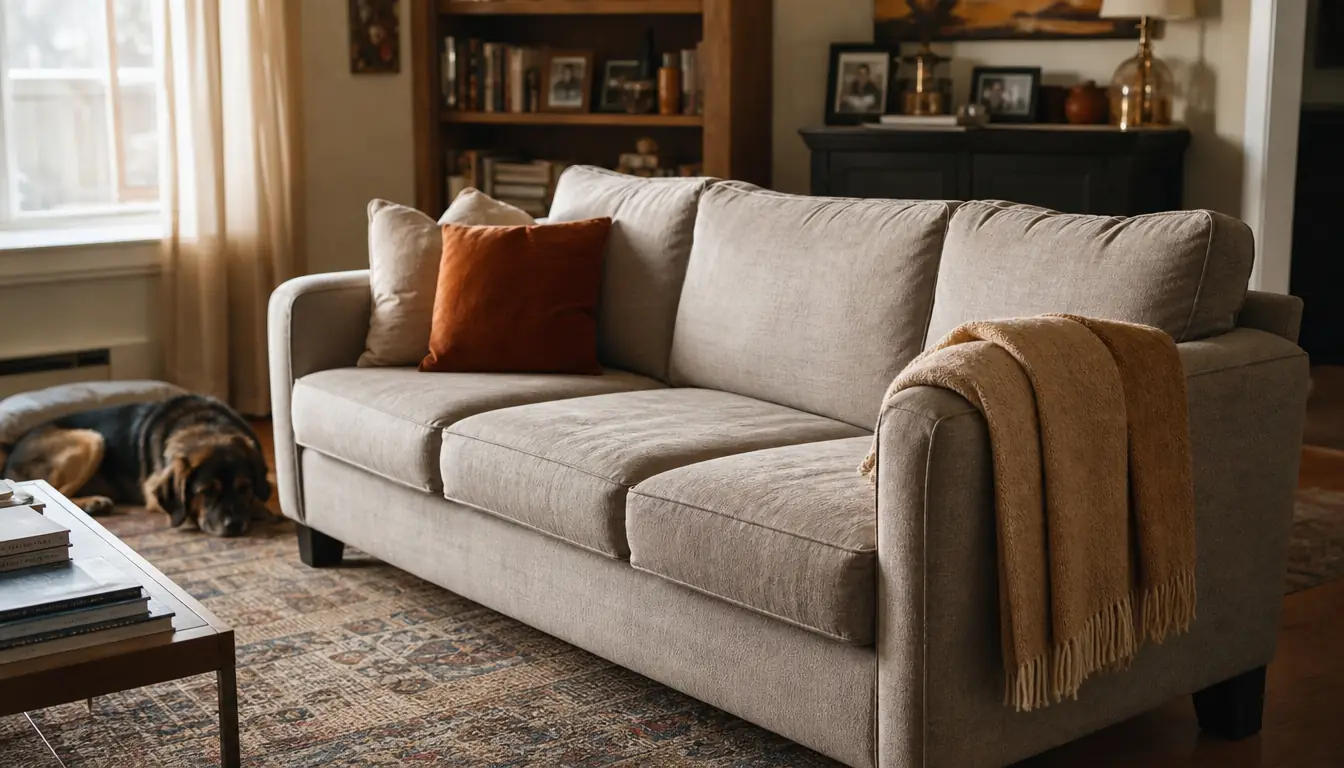
Biscuit is a thirty-pound beagle mix who sheds like it is his job, and Juniper is a ten-pound tabby who leaves a fine gray film on every cushion she sits on. Between the two of them, my living room couch stopped being furniture and became a storage unit for hair. I tried the sticky rollers first, the way everyone does. I would peel off a fresh sheet, run it over one armrest, and the sheet would be full before I ever reached the seat cushion. Then I was out of sheets, out of patience, and still sitting down on a couch that turned my dark jeans gray every single time I stood up.
That is how the ChomChom Roller ended up on the end table beside the couch this past summer. It is a manual tool. No batteries, no cord, no sheets to buy again. You roll it back and forth over the fabric, the hair collects in a small chamber behind the roller, and when you are finished you press the release button, open the housing, and tip the hair into the trash. That is the whole mechanism, and there is not much else to it. I have used mine on the couch, on Glen's recliner, on the car seat and on the stair runner, and I have had it about five months. What follows is the routine I actually run now, which is not quite the routine I imagined I would run when I first opened the box.
A tool that lives in a closet does not get used. Mine sits on the end table.
Manual, reusable, no adhesive sheets to run out of halfway through the couch. Five months of dog and cat hair in this house says the mechanism holds up.
Amazon Check Today's Price on Amazon →The Five-Step Pass I Run Once a Week
Step 1: Start on the flat panels, not the seams
It is tempting to go straight to the corner of the couch where Biscuit curls up, because that is where the mess looks worst. Hold off for a minute. Seams, piping and the ridge where the cushions meet the frame are where hair packs down hardest, and if you start there you will burn all your patience on two square inches and quit before you ever reach the open fabric. The first time I did this, I spent nine minutes on the back left seam alone, got maybe a third of the hair out of it, and then stood up and walked away from a couch that still looked gray from three feet back. That is a bad way to spend a Saturday morning. The seams come third now, and the couch gets finished.
I start on the flat of the seat cushion, working from the front edge toward the back. Long open runs of fabric give the roller something to work against and give me a fast read on whether the couch is a five-minute job or a fifteen-minute job. Most weeks it is five. The week after Biscuit blew his coat in early fall it was closer to twenty, and I stopped halfway and came back the next morning rather than pretending I was going to finish in one go. I know it was twenty because I started at ten past eight that Saturday and set the roller down for the last time at twenty-five past, with two trips to the bin and a cup of coffee in the middle. A normal week is nothing like that, and I have stopped panicking when it happens twice a year.
One honest note before you start. The tool is built for fabric and upholstery. On the smooth leather ottoman in the corner of my living room it does almost nothing, because there is no nap for it to work against. I use a damp cloth on the leather and save the roller for the couch, the recliner and the stair runner.
Step 2: Short, firm strokes, in both directions
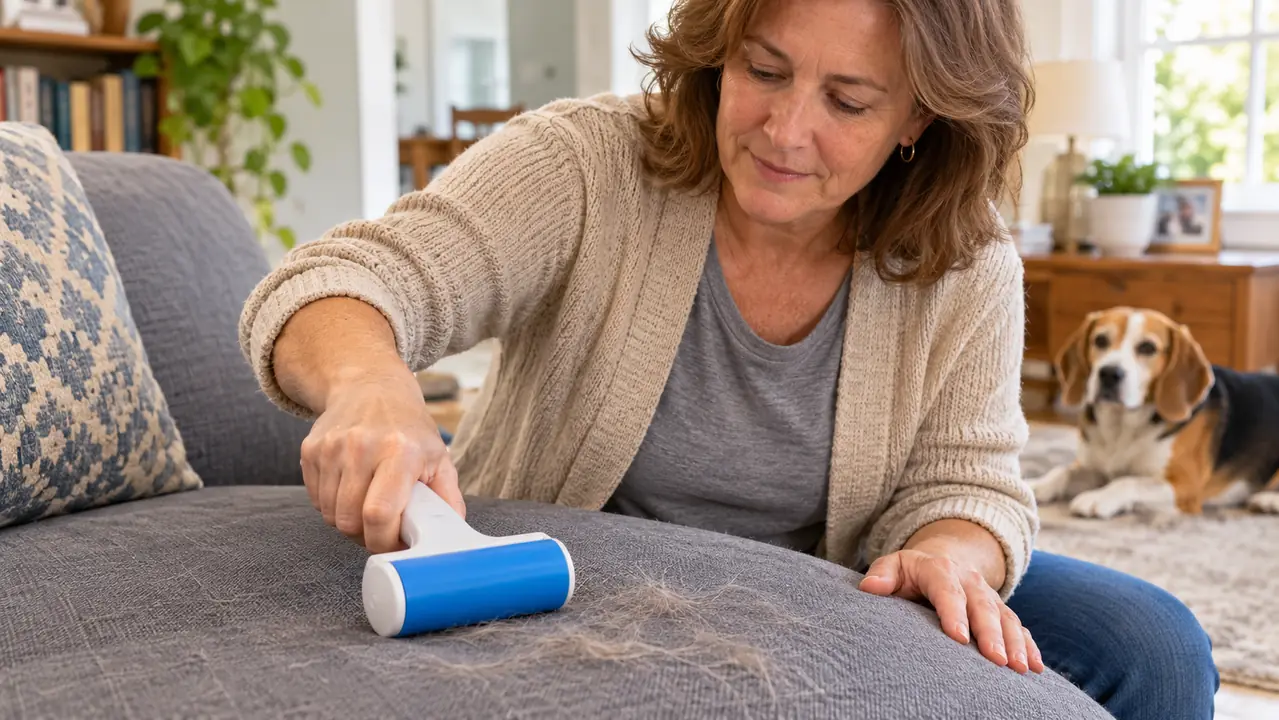
The biggest mistake I made in the first week was pushing the roller across the cushion the way I push a vacuum, in long slow sweeps. That mostly skates along the top of the fabric. Short back-and-forth strokes, maybe six inches of travel each way, put the work where it belongs. Firm enough that you feel the fabric pushing back, not so hard that you are flattening the cushion. For the first week I rolled that couch like I was pushing a vacuum across a rug: long, slow, even sweeps, arm moving from the shoulder. I finished the whole seat, sat back to look at my work, and the cushion looked exactly the same as when I started. The chamber had a faint gray dusting in it and nothing else. That is when I understood the tool wants friction, not pressure.
Go both directions over the same patch. Front to back, then side to side. Hair lies in different directions on different parts of a couch, and a patch that looks clean after a front-to-back pass will usually give up another loose pinch once you turn ninety degrees and go again. It sounds fussy. It takes about twenty seconds per cushion once you have the motion down, and it is the single change that made the biggest difference for me.
The roller weighs under seven ounces and sits in my hand roughly the way a heavy coffee mug does. That matters more than I expected. My right wrist aches from years of typing at a school office desk, and doing the whole couch does not leave it sore the way the sticky handle did. I can do the couch and the recliner back to back without stopping.
Step 3: Work the seams, the piping and the gap under the cushions
This is where the chamber fills fastest. Juniper sleeps on the back cushion in the same spot every afternoon, and the piping along the top of it holds hair like a comb. Run the roller along the seam in short strokes, following the line, and you will watch the fabric go from gray back to its actual color in two or three passes.
Then pull the seat cushions off and deal with the gap. Crumbs, hair, a pencil and at least one hair tie I had been hunting for since spring were all down in there. The roller does not reach into a deep crevice, so I sweep the loose material forward onto the flat of the couch with my hand first and roll it up from there. I pull the seat cushions off the frame about once a month now, and it takes longer to get them back in straight than it does to clean under them. The first time I did it, back in the summer, I found a dime, a pen cap, and enough hair to make a second cat.
Glen's recliner is its own separate job, and the crease where the footrest folds is the worst single spot in this house. I do that one standing up with the recliner fully open. Two or three passes down in the crease, then one across the seat, and it is finished.
Five months of a shedding beagle mix and a tabby cat comes off the arm of that couch in about four minutes. The first time I did it, the chamber was half full and I had to sit down and look at it.
Step 4: Empty the chamber before it looks full
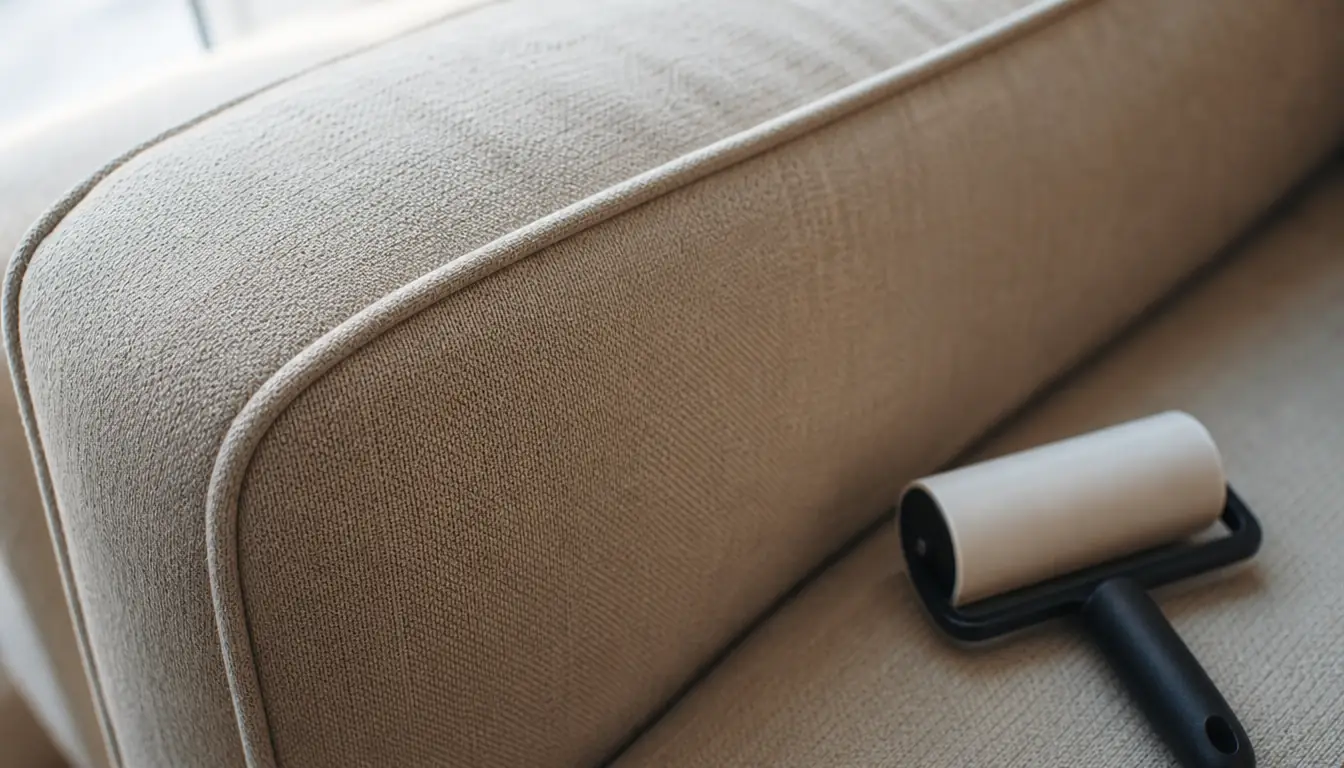
There is a release button on top of the handle. Press it down, the housing opens, and you tip the collected hair into the trash. I empty mine after every use, which sounds fussy and takes about ten seconds. Let the chamber fill and the hair starts working its way back out, and then you are rolling hair onto the cushion you just cleaned. I learned that one in August, when I left a full chamber overnight because I was tired and told myself I would finish in the morning. By morning the hair had worked back into the nap along the front edge and I did that cushion twice. Ten seconds of emptying beats a second pass.
I empty mine into the kitchen bin, holding the roller over the bin rather than over the floor, because the hair comes out in a loose clump that behaves like a small tumbleweed. In spring, when Biscuit is shedding hardest and the clumps are bigger, I take the whole thing out to the porch and empty it over the railing instead of fighting with it in the kitchen.
I have not tried washing mine. I wipe the outside with a dry cloth and leave it at that, so I am not going to tell you it survives a sink full of water. Five months of weekly use with the ChomChom Roller and the housing still opens and closes the way it did the week I brought it home.
Step 5: One slow finishing pass, then put it back where you will see it
The last pass is different from the rest. Slow, one direction, light pressure, all the way across each cushion. It is not collecting much by then. It is doing the thing that lets you look at the couch and believe it is clean, and I have stopped pretending that part does not matter.
Then the roller goes back on the end table beside the couch. Not in the hall closet, not in the drawer with the batteries. I know exactly how this works in my house. Anything that lives in a closet gets used twice and then gets forgotten, and the sticky roller lived in a closet for two years. The ChomChom Roller sits out where I can see it, next to the remote, and that is the entire reason it gets used weekly instead of twice a year. Glen laughs at me for keeping it there. He is also the one who noticed his recliner stopped turning his work shirts gray, so he can laugh.
The whole pass takes four to six minutes on the couch, about two on the recliner, and another two on the stair runner when I am being thorough. I do the full job on Saturday morning while the coffee is going. On weekday mornings I do a quick pass over the arm of the couch where Biscuit leans, which takes about thirty seconds and keeps the rest of it from getting bad.
What Else Helps
The ChomChom Roller is the last step in this house, not the only one. Most of the hair is on the animals before it is ever on the couch, so the grooming rake gets used on Biscuit out on the back porch twice a week, ten to fifteen minutes a session. When I keep up with that, the couch job drops to about four minutes. When I skip it for two weeks, I pay for it on the couch.
A washable throw blanket over the seat cushion does a lot of quiet work. I keep one on the seat Biscuit uses most, wash it every Sunday with the towels, and the cushion underneath stays close to clean. It is not a solution, it is a trade. You are still washing hair, just in a machine instead of by hand on a Saturday morning.
The vacuum still has a job. The roller is for surfaces and for the last of the hair on them. It does not get down into the carpet pile on the stairs and it does nothing for the dust under the couch. I vacuum the stairs every other week and roll the runner in between.
What it will not do: it will not work on the pets themselves, it will not lift years of packed hair out of an old couch seam in one session, and it will not turn anyone into a person who enjoys housework. What it does is end the sheet-by-sheet cycle. I have not bought a sticky roller refill since summer, and I have not had to stand up and brush myself off after sitting on my own couch in five months.
Five months, one reusable tool, and not a single refill bought since summer.
If your couch has turned into a hair repository, this is the simplest fix I have found that does not run out of sheets halfway through the job. Mine lives on the end table and gets used every week.
Amazon Check Today's Price on Amazon →