
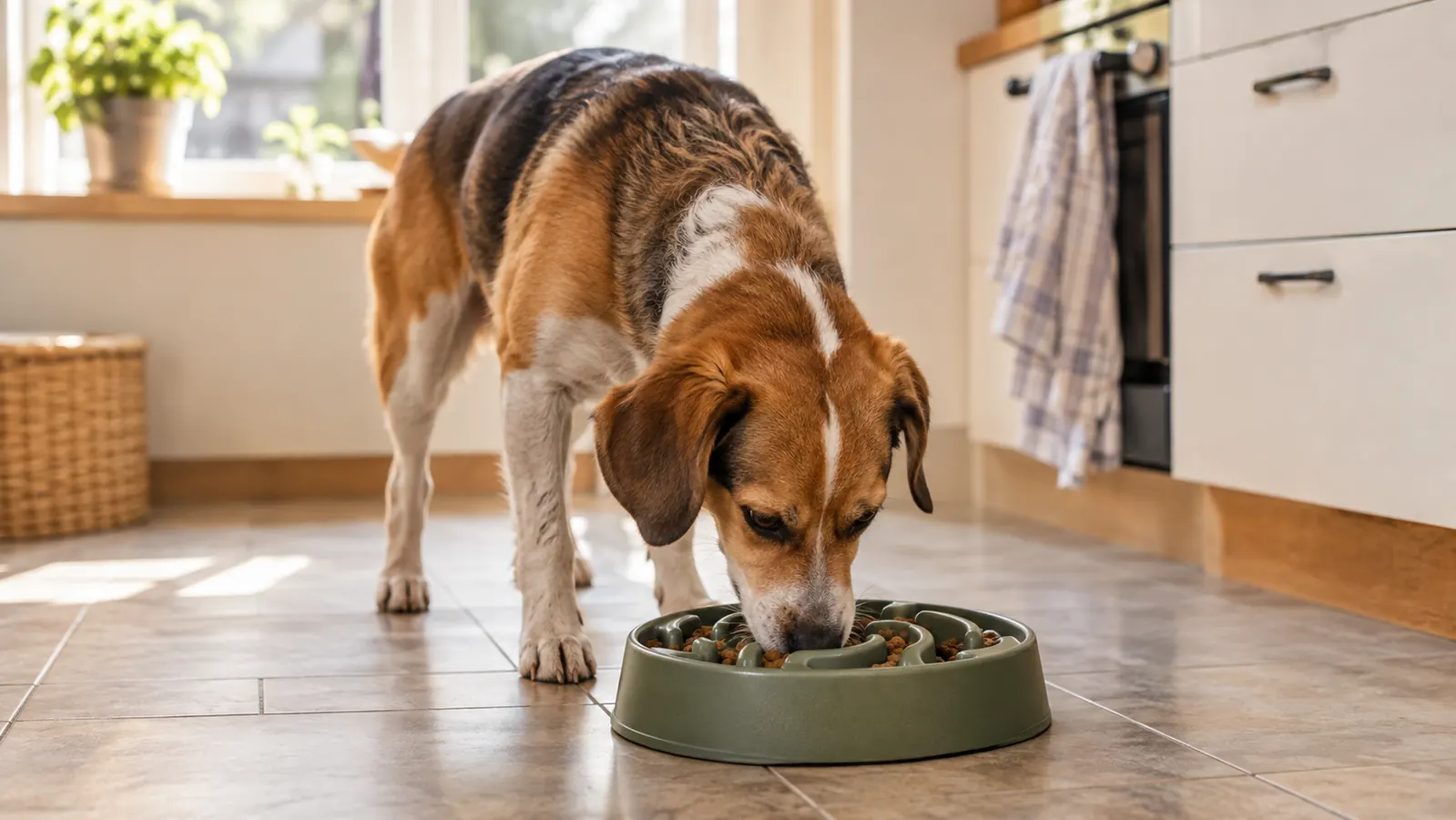
Biscuit used to finish breakfast before I had my coffee poured. He is a 7-year-old mixed breed, mostly beagle, about 30 pounds, and we adopted him from a county shelter six years ago. Food is his favorite subject. For a long time I thought a fast dog was just a hungry dog. Then he started bringing meals back up on the kitchen floor, sometimes within a minute of finishing, and I stopped finding it funny.
I tried the usual things. I spread kibble on a cookie sheet. I dropped a tennis ball in his regular bowl. I stood over him and told him to slow down, which did nothing except make me feel involved. What finally worked was a bowl with a maze in it, the Outward Hound Fun Feeder Slo Bowl in the Notch pattern. I bought it last summer. It is plastic, it holds 2 cups, and it has been on my kitchen floor for about six months. This is how I use it, what annoyed me, and who I would not buy it for.
The 2-cup bowl that made Biscuit work for his breakfast
Outward Hound Fun Feeder Slo Bowl, Notch pattern. Holds 2 cups of dry or wet food, 8.5 inches across and 2 inches tall, dishwasher safe. It is the bowl I reach for twice a day.
Amazon Check Today's Price on Amazon →How I've Used It
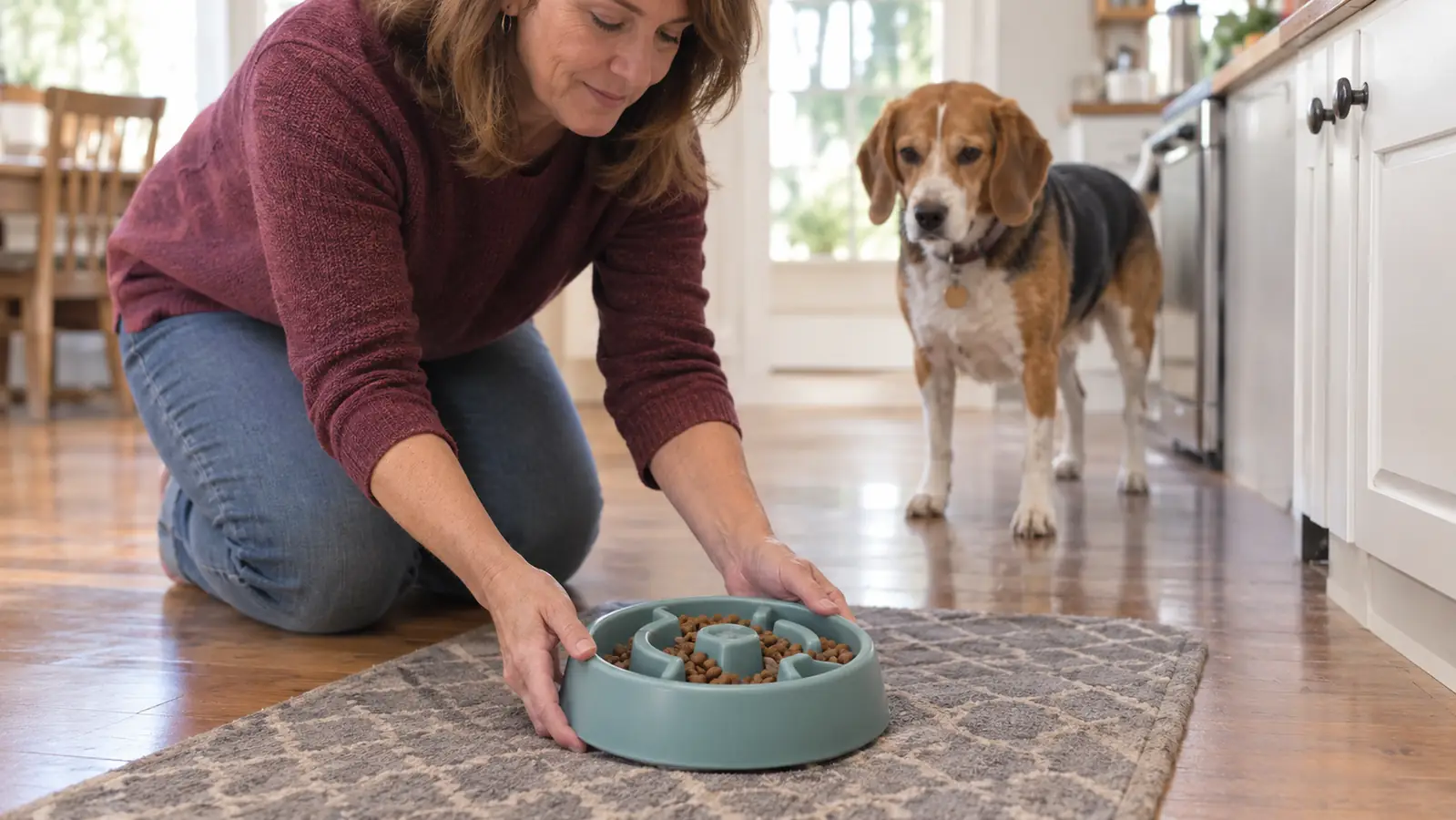
I feed Biscuit twice a day in the same corner of the kitchen, on the same mat. The bowl holds 2 cups, which is more than his measured portion, so there is room to spread the kibble through the maze instead of dumping it in one spot. The listing calls this the SLOW level, meant for small to medium dogs. Biscuit is 30 pounds, so medium is the right lane for him. The bowl is 8.5 inches across and 2 inches tall, and it weighs 8 ounces empty. That matters when you are carrying it to the sink with one hand and holding the pantry door with the other.
I hand-wash it most days because I am already at the sink, and I run it through the dishwasher when I am not. The listing says dishwasher safe. After six months of twice-daily use, the surface has fine scratches from kibble and from the sink, but no cracks. I have not tried wet food in it. The listing says it works for wet food too, but Biscuit eats dry kibble, so I cannot tell you how that goes.
Why I Picked the Outward Hound Bowl
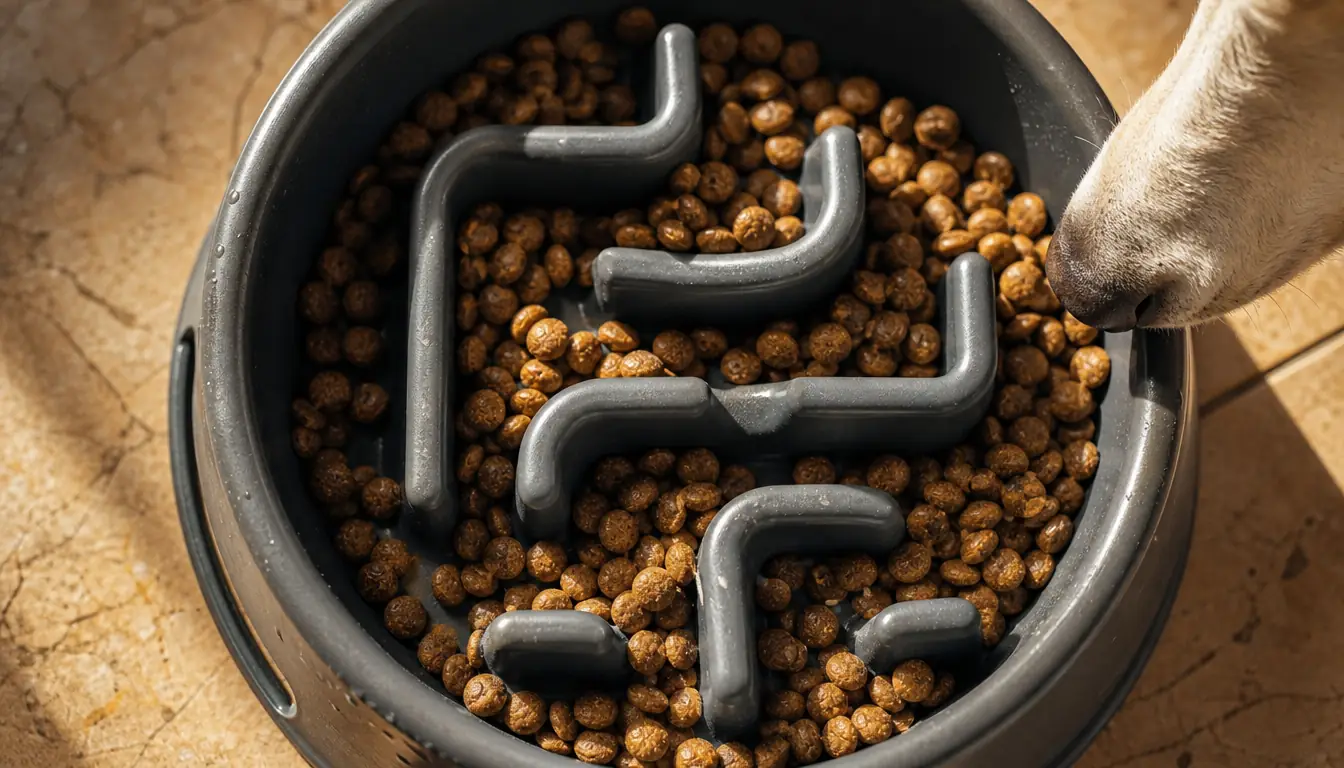
I did not compare every slow feeder on the market. I picked the Outward Hound because it was the one I could find in a store with a 2-cup capacity and a pattern that looked simple enough for Biscuit. I was not looking for a puzzle that would take him twenty minutes. I wanted a bowl that would add a few minutes and some work, not a project. The Notch pattern is a maze in a shallow bowl. The listing calls it a simple puzzle feeder. It is not a complicated maze. That is why it worked for us.
The other reason was the size. Biscuit is 30 pounds, and the 2-cup bowl is meant for small to medium dogs. A bigger bowl would let him take bigger bites. A smaller bowl would have him nosing the edge. The 2-cup capacity fits his meal with room to spread it out. I also liked that it is plastic and dishwasher safe. I have enough hand-wash-only items in my kitchen. I did not want another one.
The Steps That Worked for Us
Step 1: Pick the size that matches your dog, not the biggest bowl on the shelf
Slow feeder bowls are not one-size. The Outward Hound bowl comes in multiple sizes and three slow levels, and this one is the SLOW level with a 2-cup capacity. For Biscuit, that is right. A smaller dog would have to stretch to reach the maze, and a much larger dog could empty it quickly. If your dog is a serious gulper, the brand makes SLOWER and SLOWEST versions. I have not used those, so I will not pretend to compare them.
Measure your dog's normal meal first. If you free-feed, this bowl will not fix that. I put Biscuit's measured portion in the bowl, set it down, and walked away. The first meal took him about four minutes, which was four times longer than his old bowl. The listing says it can slow eating up to 10X. I would not hang a stopwatch on that number, but the direction is right.
Step 2: Introduce it when your dog is calm, not at the hungriest meal of the day
I used dinner, not breakfast. Biscuit is wound tighter in the morning. I put the new bowl down in the usual spot, with his usual food, and stood back. He nosed the rim, licked the middle, and then started working the maze. The first two minutes he kept looking up at me like I had made a mistake. I did not add food or move the bowl. He figured it out.
Do not stand over the bowl and narrate. I did that once and he stopped eating to watch me. Put it down, leave the room if your dog will let you, and let the bowl be the job. If your dog is food-guarding, this is not the moment to test a new bowl. Feed separately and talk to a trainer.
Step 3: Load the maze, do not pack the bowl
The point is not to make the food disappear into a solid block. I spread the kibble into the maze with my fingers, one layer deep. If I dump it in the center, Biscuit pushes it to the edge with his nose and gets a mouthful anyway. The Notch pattern is a maze, and the food has to be moved around it. The bowl is 2 inches tall, so it is not a deep well. That is good for a dog that gets frustrated.
Some people soak the food or add wet food to make it stick. I have not done that. If you do, remember the listing says wet food is fine, and wash it sooner. A plastic bowl with wet food in the maze is not something you want to leave on the floor overnight.
The first week, Biscuit spent more time looking at me than at the bowl. By day four, he was working the maze like a job.
Step 4: Watch the first week and adjust the setup, not the bowl
Biscuit's first week was messy. He pushed the bowl across the floor, which is what a light 8-ounce bowl does on hardwood. I put a thin rubber mat under it, not because the bowl came with one, but because I already had one for his water. The bowl itself has no rubber ring that I can see. That is one of my complaints.
After four or five days, he stopped pushing. He also stopped inhaling. Meals went from under a minute to several minutes. I did not change his food or his portion. I did split his dinner into two smaller loads in the same bowl once or twice when he seemed to get tired of working, but most days one load is fine.
Watch for frustration. If your dog walks away, picks the bowl up, or starts chewing the rim, take a break and try a shallower bowl or a different pattern. A slow feeder should be work, not a fight.
Step 5: Clean it every day and check it for damage
Plastic bowls get slimy. I rinse this one after every meal and hand-wash it most days with a bottle brush at the sink. The maze is shallow enough that a sponge gets into it. The listing says dishwasher safe, and I have run it through, but I still hand-wash more often because it is faster than loading it.
Once a week I hold it up to the window and look for cracks or rough spots. After six months, the bottom has a few light scratches. Nothing has chipped. If it does crack, I will replace it. A cracked plastic bowl is not worth the risk of a cut tongue or a piece coming off.
Keep the routine. Same spot, same times, same bowl. Biscuit now waits by the mat at 7 and 5. The bowl did not train him to be patient. It just made his meal last long enough that his mouth had to keep up with his stomach.
What Else Helps
Slow feeder bowls work better when the rest of the routine is not working against them. In our house, that meant separating Biscuit from Juniper's food. Juniper is our 4-year-old tabby, and her food lives in the laundry room behind a gate. Biscuit cannot get to it. If your dog is eating fast because another pet is circling, a slow feeder will not fix the competition. Feed them in different rooms.
Other things I tried that helped a little: scattering kibble in the grass in the backyard, using a muffin tin with a few treats in the cups, and feeding smaller meals more often. The muffin tin was a pain to wash. The grass scatter only works when it is not raining. The slow feeder is the one that stayed.
Other people use snuffle mats or puzzle feeders. I tried a snuffle mat at a friend's house. Biscuit liked it, but it held hair and crumbs and I did not want another thing to wash. The slow feeder is easier for us because it is one piece and it goes in the sink. If your dog needs more challenge, a puzzle feeder may be better. If your dog needs less, a regular bowl with a tennis ball is not enough. The slow feeder is the middle ground.
If your dog is vomiting after meals, losing weight, or seems painful when swallowing, call your vet. I am not one. This is a bowl, not a diagnosis. For Biscuit, the issue was speed. The bowl helped with speed.
What I Wish I Knew Before I Bought It
I wish I had known that the bowl would slide. The first week, Biscuit pushed it from the mat to the baseboard. A rubber mat fixed it, but the bowl did not come with one. If your kitchen floor is hardwood or tile, plan for that. I also wish I had known that the first two meals would look like a failure. He walked around it, nosed it, and looked at me. I almost put his old bowl down. I am glad I did not.
I wish I had known to wash it right after dinner. The maze is shallow, but kibble dust collects in the corners. If I leave it until morning, it is a bigger job. A quick rinse and a bottle brush takes less than a minute. That is the trade. The bowl adds a few minutes to his meal and a minute to my cleanup. I will take that trade.
Who This Is For
This bowl is for a small to medium dog that eats dry food too fast and needs a simple puzzle in front of him. It is also for the person who wants a bowl they can wash without a brush set and a dismantling routine. The 2-cup capacity suits a dog Biscuit's size. The plastic is light, the bowl is simple, and the Notch pattern is not so complicated that a dog gives up. If you have been through three regular bowls and a muffin tin, this is the next thing I would try.
It also helps if you feed at set times. Biscuit knows the schedule, and the bowl slots into it. I put the bowl down, he works, and I get to finish my coffee while it is still warm. That is the whole review, really.
Who Should Skip It
Skip it if your dog is a serious power chewer. This is plastic, and a determined dog can put teeth into it. Skip it if your dog is much larger than 30 pounds or already used to a harder puzzle; this SLOW level may be too easy. Skip it if you want a bowl with a rubber base, because mine does not have one. And skip it if you are not willing to wash it. The maze holds a little kibble dust, and a bowl that sits dirty on the floor is worse than a regular bowl.
I would also skip it if your dog is already stressed at meals. A slow feeder adds a small obstacle, and a stressed dog does not need another obstacle. Fix the stress first. The bowl is for a healthy dog with a bad habit, not a dog with a medical problem.
If your dog is done eating before you sit down, start here
The Outward Hound Fun Feeder Slo Bowl holds 2 cups, is dishwasher safe, and has survived six months of twice-daily meals in my kitchen. It will not train your dog. It will make him work for dinner.
Amazon Check Today's Price on Amazon →