
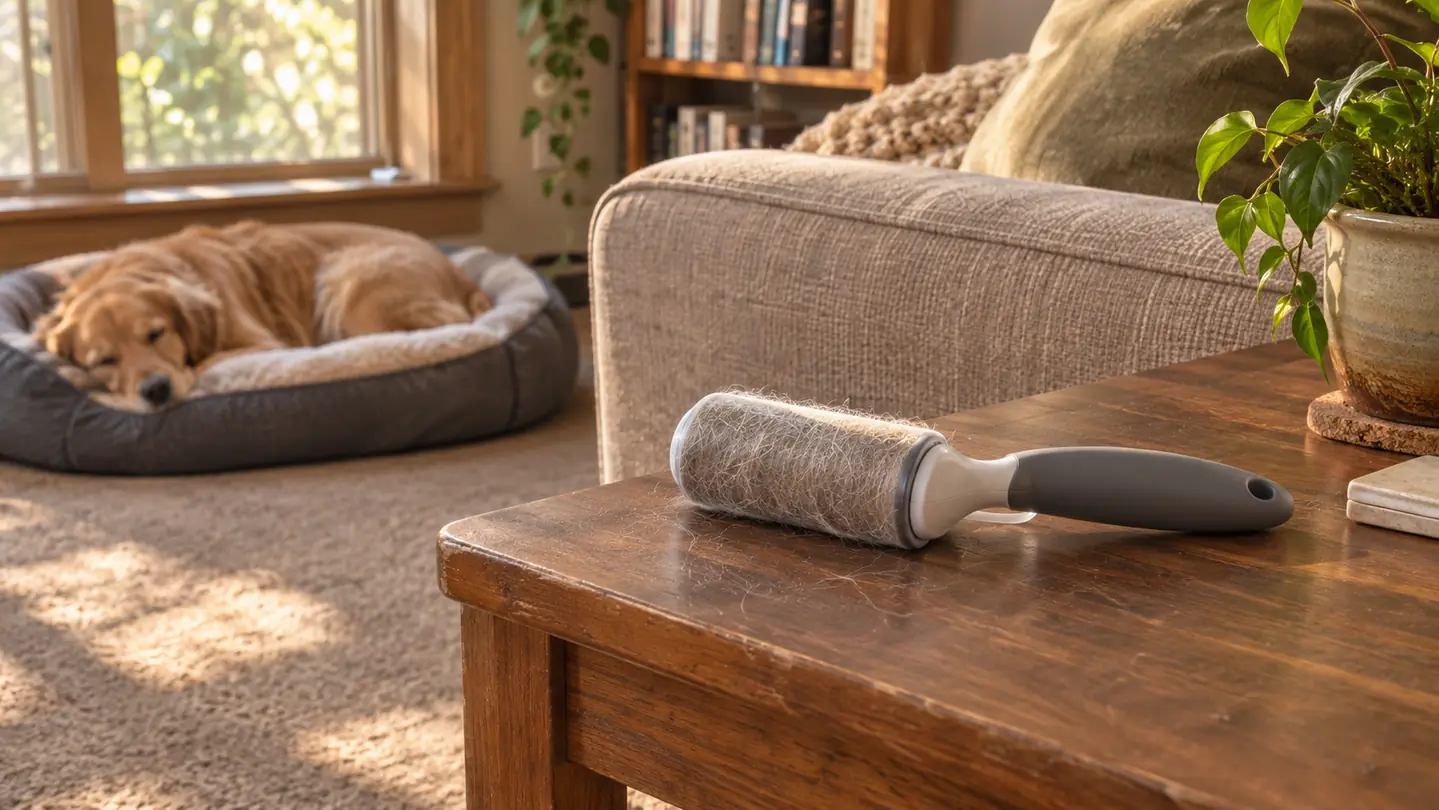
Here is the thing about a reusable pet hair roller. The listing photos make it look like a magic wand, and it is not a magic wand. It is a plastic tool you push back and forth with your own arm. I bought the ChomChom Roller this past summer because our couch had reached the point where guests brushed off the seat before sitting down, and I had already given up on sticky sheets. Five months later it lives on the end table by the couch, and I have used it enough to know exactly where it helps and exactly where it does not.
Most write-ups on this thing stop at 'it picks up hair, five stars.' That is true, and it is also the least interesting part. The interesting part is that it is a manual tool with a manual tool's tax, and it has a short list of surfaces it handles well and a short list it does not. Know both lists before you buy and you will be glad you did. Find out the hard way and you will be annoyed by week two. So this is the version I wish someone had handed me in the store.
The Quick Verdict
A genuinely useful tool for fur on upholstery, with a manual labor tax and a few fabrics it simply cannot handle.
Amazon Check Today's Price →Strong on upholstery, honest about everything else
If the problem is fur on a couch, a recliner or a car seat, this is the tool I keep within reach. Worth a look before the next shedding season.
Amazon Check Today's Price on Amazon →What This Thing Actually Is
The ChomChom Roller is a handheld tool measuring 7.5 inches wide, 7.5 inches tall and 2.5 inches deep, and it weighs 6.72 ounces. The handle is plastic. It operates manually, which means no motor, no battery, no cord and no adhesive. You press the face of it against the fabric, work it back and forth in short strokes, and the fur collects in a chamber inside the body. When the chamber fills, you press the release button, the tool opens, and you tip the hair into the trash.
That is the entire machine. There is nothing to refill and nothing to plug in, and nothing has worn out on mine. The dimensions matter more than they sound. The 2.5 inch depth is what lets it slide along the lip of a cushion and the arm of a recliner. The 7.5 inch face is what turns a three-cushion couch into a five minute job instead of a twenty minute one. It also means it does not fit in a glovebox. This is a drawer tool or an end table tool, not something you carry in a purse.
It is worth being clear about what it is not. It is not a vacuum and it is not a sticky sheet. It will not pick up crumbs, grit or the sand that comes in on shoes, and it will not clean a floor. What it does is pull loose fur out of fabric that is staying still. That is a narrow job, and the tool does it well, but you should not buy it expecting a broom and a vacuum to become unnecessary.
How I've Used It
Our dog Biscuit is a 7-year-old beagle mix, about 30 pounds, and he sheds more than anyone warned us when we adopted him from the county shelter. Our cat Juniper is a 4-year-old short-haired tabby, indoors only, and she has claimed one arm of the couch as her property. So the couch takes the worst of it. Dog fur along the seat cushions where Biscuit leans, cat fur on the arm where Juniper sleeps, and a general haze on everything in between. The roller goes on the couch, on Glen's recliner and on the car seat, roughly every other week.
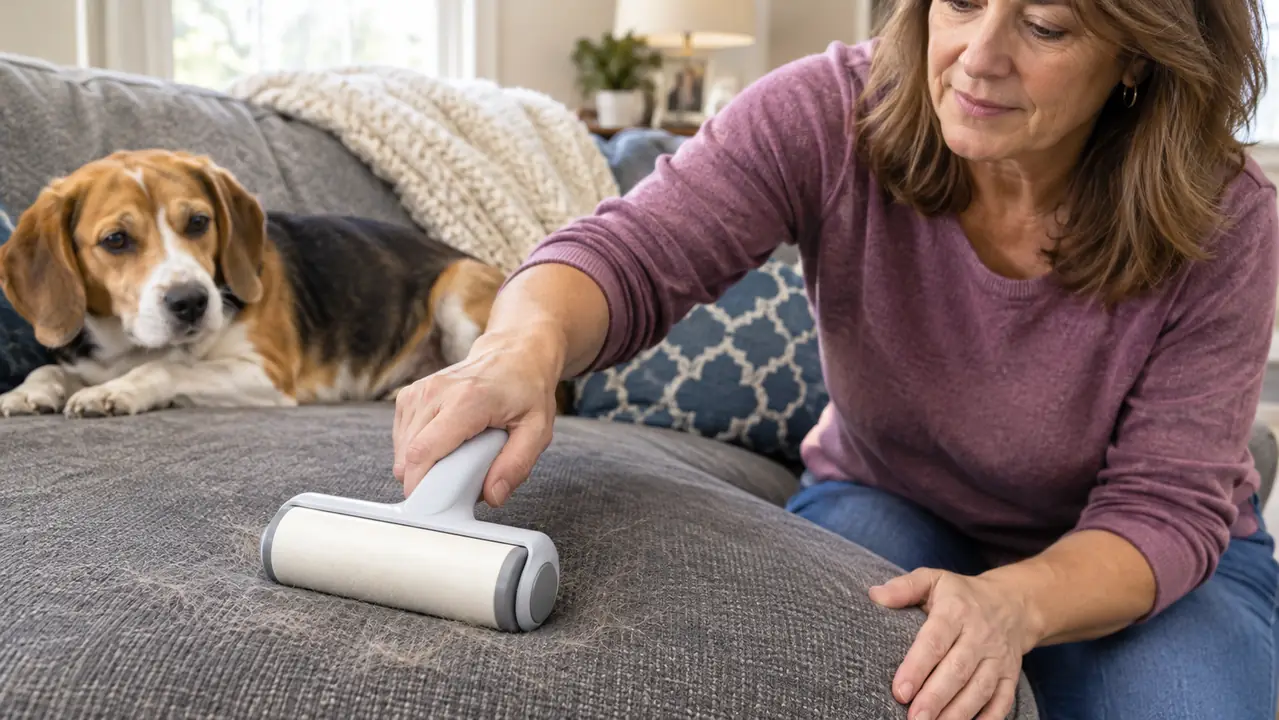
The routine is simple. Short strokes, overlapping, moderate pressure. Seat cushions first, then the back, then the arms. A three-cushion couch takes about five minutes if I stay on task. Glen's recliner takes two. The car seat takes closer to ten, mostly because of the angle and because I am reaching across from the passenger side with my knees on the console.
The first week I got it wrong. I treated it like a sticky sheet, quick light passes, and after ten minutes the couch looked maybe a third better and my arm was tired for nothing. Then I stood still and pressed down, and the difference was immediate. Now I work in patches. Twelve seconds of back and forth in one spot, then over by half the width of the tool and repeat. That is the whole technique, and it took a week and a sore shoulder to learn it.
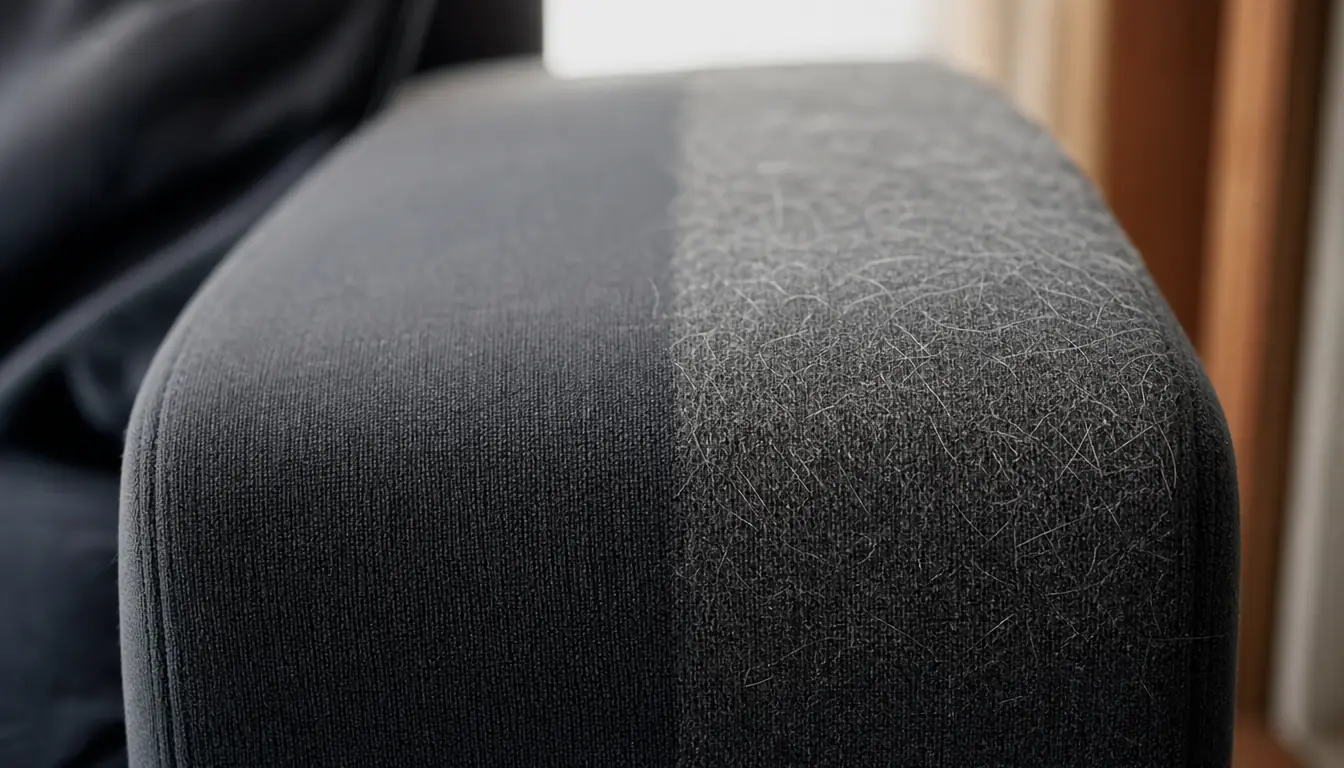
Our couch is a tight-weave microfiber we bought four years ago, and Juniper's fur has been working into those seat cushions since roughly the second month we had her. The first real pass with the ChomChom Roller pulled up a grey haze of hair I had stopped seeing. Satisfying, and also a little disgusting once I realized how long it had been there.
I empty it after every session. That is not in the instructions as far as I remember, it is just what the chamber demands when your dog sheds the way Biscuit does. Press the release button, tip it over the kitchen trash, and it is ready for next time. Five months in, it works the same as it did the first week. No refills bought, nothing replaced.
Where It Falls Short
It is manual labor, and there is no getting around that. Five minutes of firm strokes on a couch is nothing. Doing the couch, the recliner, the stairs and the whole car interior in one afternoon is a forearm workout, and I have quit halfway through more than once. If the fur problem is house-wide, this is a supplement to a vacuum, not a replacement for one.
It also wants pressure and short strokes, and this is where people get frustrated. If you glide it fast and light, it skims the top layer and leaves the fur that has worked into the weave. Slow down, press down, use strokes about six inches long, and go over the same patch twice. Done that way, it lifts hair that a sticky sheet had been smearing around. Done in a hurry, it looks like the tool is not working when the real problem is the technique.
Fabric decides everything. Tight-weave upholstery, the couch, the recliner, the car seat: it does well on all of those. Our low-pile area rug is fine. But the loose knit throw in the guest room is a losing battle, and the plush bath mat is worse. Loose, fuzzy, high-pile fabric moves with the stroke instead of staying put, and the tool cannot grip what will not hold still. That detail is nowhere in the listing photos, and it matters if half your furniture is that kind of fabric.
I tested it on six things around the house to be sure this was a pattern and not me being clumsy. Couch, recliner, car seat and the low-pile runner in the hall all behaved. The loose knit throw on the guest bed, the plush bath mat and the upholstered headboard in the spare room all fought back. On the throw, the fabric rode up under the tool and I spent more time chasing the blanket around the bed than I did on the hair. On the headboard I could not get enough flat surface behind the tool for it to grip. Those three surfaces now get a vacuum attachment and thirty seconds of my time, and I have stopped trying to make the roller do a job it was not shaped for.
Slow down and press down and it lifts fur a sticky sheet only smeared around. Rush it and it looks broken.
Emptying has a small catch. The chamber fills faster than you expect with a heavy shedder, which is why I empty it every time. The release button opens the tool cleanly, but the hair does not always drop out on its own. Fine cat hair clings to the inside, and I usually pull a clump out with my fingers. And empty it over the trash, not over the couch you just finished, which is a lesson I learned the ordinary way.
The edges of the tool are another small thing. On a cushion with a piped seam, fur collects right along the seam and the roller will not get down into it. I end up running a damp fingertip along the seam afterward. Small, but it is the kind of gap that makes the five minute job into a seven minute job.
Hard floors, baseboards, and the gap where the cushions meet the frame are all vacuum jobs. The stairs are a vacuum job. It handles one category of mess, fur on fabric, and it does not pretend to handle more.
The car is the awkward one. The slim profile helps along the seat bolsters, but there is no extension handle, so reaching the floor mats and the space between the seat and the console means folding yourself into the footwell. I do the seats and let the vacuum handle the rest.
The Cat Hair Question
I expected it to be better on dog fur than cat fur, and it went the other way. Juniper's hair is shorter and finer, and where she sleeps on the couch arm it had worked into the fabric in a way sticky sheets could not touch at all. Two passes and that arm looked like a different piece of furniture. Biscuit's fur is coarser and sits closer to the surface, so it comes up fast, but there is more of it and it fills the chamber quicker.
The honest version is that it handles both, and the cat hair result surprised me more because I had lower expectations going in. If you have a short-haired cat and a fabric couch, that may be the strongest use case there is for this thing.
What It Does Well
The obvious one: no refills, no adhesive, nothing to buy again. Over five months that has meant no trips to the store and no sheets peeling off the roll at the wrong moment. It sits on the end table, which means I use it in the ten seconds after I notice the fur instead of adding it to a list of chores I will get to later. Convenience is most of the value here, and that is not a small thing.
Before this I was buying sticky-sheet rollers by the two-pack and burning through a full roll every couple of weeks, almost all of it on the couch. That habit is gone. The other change is where the tool lives. A sticky roller in a closet is a tool I forget about. This one sits within arm's reach of the cushions that need it, and that single change in placement has done more for the fur situation in this house than anything else I have bought for it.
It also does not mark the fabric. No sticky residue, no pilling I can see on anything I have used it on, no damp patches. And it is quiet, because it is manual. I have used it at eleven at night while Glen was watching something, and nobody turned around. A vacuum at that hour would have been a different conversation.
I tried the rubber glove trick before this, the one where you dampen a dish glove and drag the fur into a pile. It works, sort of, and it is free. It is also slower, it leaves the fur in a pile you still have to pick up, and my hand was done after one cushion. This tool is not free, but it is faster and it does not require me to put on a glove first.
What I Liked
- No refills, no adhesive, no batteries. Nothing to buy after the first purchase
- Lifts cat hair that had worked into the couch fabric, which sticky sheets could not touch
- The 7.5 inch face makes a three-cushion couch about a five minute job
- The 2.5 inch depth slides along cushion lips and recliner arms
- Light at 6.72 ounces, so it stays on the end table and actually gets used
- No residue and no visible pilling on tight-weave upholstery
- Quiet, because there is no motor
Where It Falls Short
- Manual. Your arm does all the work, and a whole-car afternoon is tiring
- Needs short, firm strokes. Fast and light does almost nothing
- Fights loose knit, plush and high-pile fabric
- Fills up fast with a heavy shedder and needs emptying after each session
- Fine hair clings inside the chamber and often has to be pulled out by hand
- No extension handle, so car footwells and under-cushion gaps stay a vacuum job
- Will not clear fur packed into a piped cushion seam
Five Months In
The question I actually care about with anything reusable is whether it survives. This one has. The release button still opens smoothly, the face still grips, the plastic handle has not cracked or loosened, and there is nothing to service. I wipe the outside with a damp cloth now and then. That is the whole maintenance routine, and it has not needed a single replacement part.
It has taken a couple of knocks, too. In September I set it too close to the edge of the end table while I answered the phone and it went down onto the hardwood in the kitchen doorway. The corner scuffed and nothing else happened. The release button still snaps open, the chamber still seats properly when it closes, and the face has not lost any grip. I have checked the inside of the chamber for cracks twice because it feels like thin plastic in the hand, and both times it was fine.
Would I buy it again? Yes, which is not a small thing given the complaints above. Every one of those complaints is real, and every one of them is about the tool being honest about what it is. It pulls fur out of fabric using your arm, and it does that better than anything else I have tried on a couch. It is not a vacuum and it is not magic.
Who This Is For
You have a shedding dog or a short-haired cat, at least one fabric couch or chair that collects the fur, and you are tired of peeling sticky sheets that fill up in a single pass. You want something within reach that takes ten seconds to grab. You are willing to do the work with your own arm. That is the sweet spot, and in that spot the ChomChom Roller earns its place on the end table.
Who Should Skip It
Skip it if your furniture is mostly loose knit, plush or high-pile fabric, because the tool fights those surfaces and loses. Skip it if you were hoping something would save your arm, because nothing about this does. Skip it if the fur problem lives on hard floors, stairs and baseboards. And skip it if you want one tool for the whole house. This is one tool for one job, and buying it expecting more is how you end up writing an angry review by week two.
One tool, one job, and it does that job on the couch
Five months of steady use and it still sits on my end table. If fur on upholstery is your problem, this is the one I would hand you.
Amazon Check Today's Price on Amazon →