
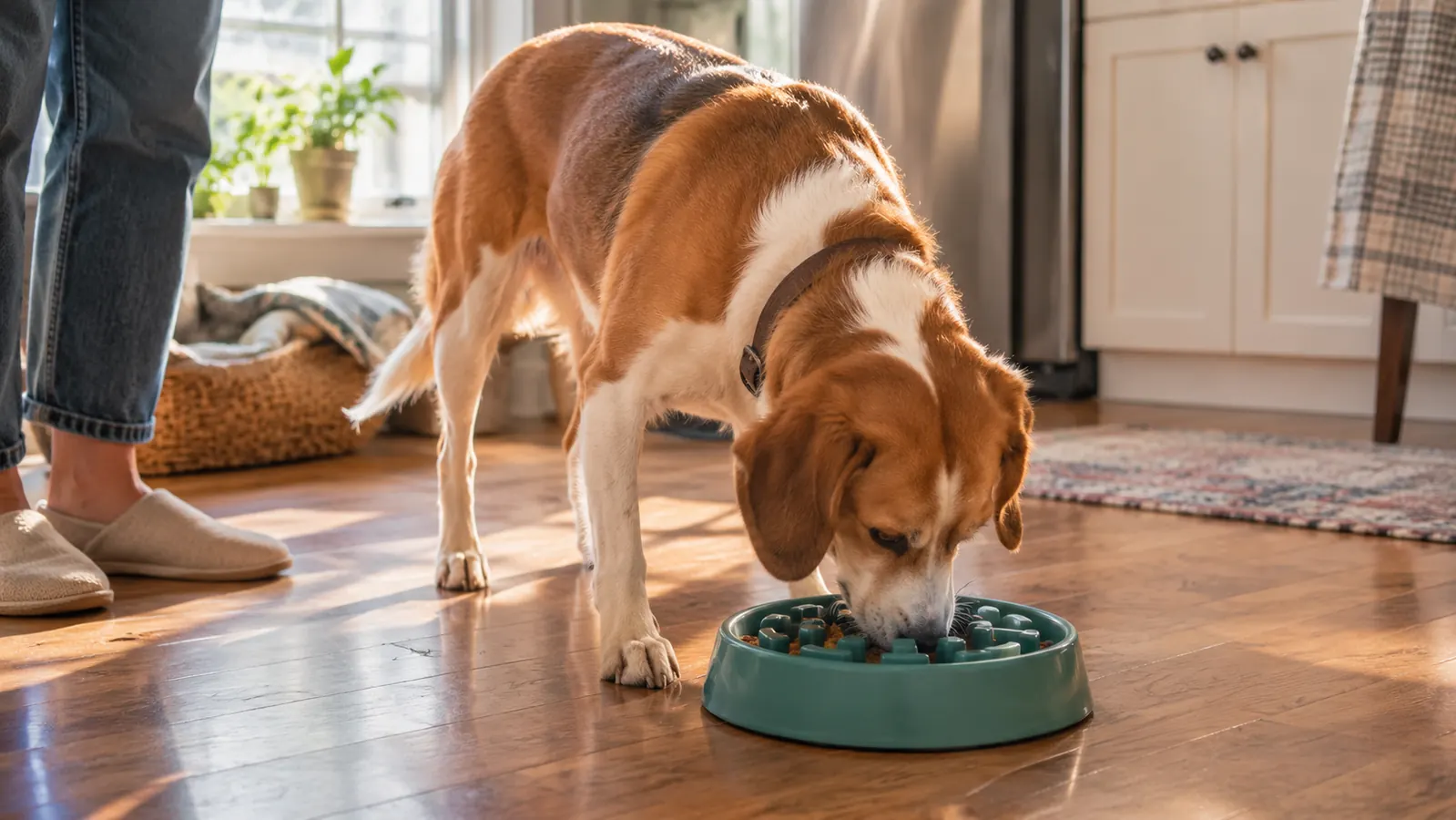
Biscuit has never met a meal he wanted to slow down. For the first few years I had him, dinner was gone in under a minute, and about twice a week it came back up on the kitchen floor while I was still standing there holding the bag. I tried splitting his food into two smaller servings. I tried a muffin tin, which he defeated inside a week. I tried standing over him saying easy in a voice he completely ignored. Last summer I bought the Outward Hound Fun Feeder Slo Bowl, the notch pattern, and I have fed him out of it twice a day ever since. This is the honest version of that story, including the parts I did not expect and the parts that still annoy me.
Most slow feeder reviews stop at the bowl works, and it does. What they leave out is that the bowl changes your routine along with your dog's, and some of those changes are chores nobody mentioned to me before I bought one. I am not a veterinarian and I am not going to make claims about bloat or about what your dog's stomach does. I am a school office manager outside Tulsa with a seven-year-old beagle mix who eats like the food is about to be repossessed. What follows is what six months of daily use actually looked like in my kitchen, the good and the irritating.
The Quick Verdict
It stretched a forty-second meal into several minutes, and the 2-cup capacity covers Biscuit's portions without a second bowl. It also means hand-washing most days, and it will not stop a determined dog from pushing it across a hard floor.
Amazon Check Today's Price →The bowl that made Biscuit chew instead of inhale
The Outward Hound Fun Feeder in the notch pattern holds 2 cups and, by the manufacturer's count, slows eating up to ten times. Six months of twice-daily meals in my house says the slowing part is real.
Amazon Check Today's Price on Amazon →How I've Used It
The bowl lives on the kitchen floor beside the water dish and has been in service for most of this year. Biscuit gets two meals a day, roughly six in the morning and half past five at night, and both go into this bowl. He runs about thirty pounds, which puts him at the top of the range the medium size is built for, and a rounded scoop and a half fills the maze without coming close to the rim. The first time I set it down he nosed at it, looked up at me like I had made an obvious mistake, and then went to work.
The first week was clumsy. He pushed it toward the stove twice and I found kibble under the bottom drawer of the cabinet. He also tried to pick the whole thing up by the rim, which is exactly the kind of thing a beagle will attempt. It weighs eight ounces, so he could slide it, but he could not tip it, and once he understood the food was not going anywhere he settled in and started working around the ridges. By the end of that week a meal was taking minutes instead of seconds, and I stopped standing there watching him do it.
Six months in, the routine is boring in the best way. Bowl down, dog works, I unload the dishwasher. Twice a day, every day, and I have not had a meal come back up on the floor since we made the switch. That is the part I care about most and the part I would tell anyone standing in my kitchen asking whether it is worth the trouble.
What the Bowl Actually Is
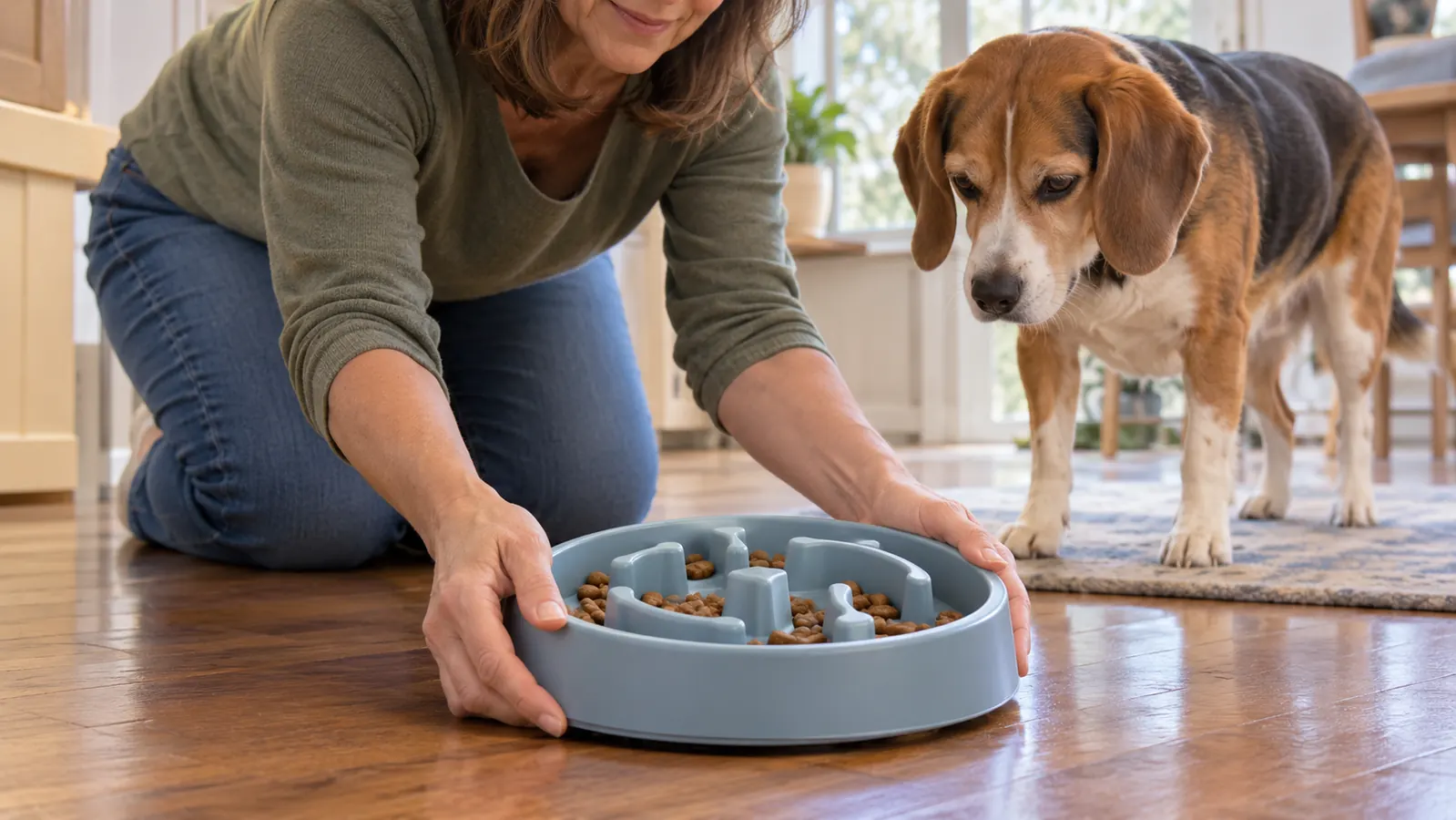
It is one piece of plastic, 8.5 inches square and 2 inches tall, weighing 8 ounces, with a maze molded into the bottom that the listing calls a notch pattern. It holds 2 cups of dry or wet food. This one is the SLOW level, the mildest of the three levels Outward Hound makes, and it is sized for small to medium breeds, with the listing naming Boston terriers, pugs, French bulldogs and shih tzus. Biscuit is bigger than all four of those and it still works for him, but a Labrador would need a different size and possibly a different level.
The idea behind it is simple enough. Instead of an open dish, the food sits in channels the dog has to work around, so every mouthful costs a few extra seconds. There are no buttons and nothing to assemble, which I appreciate more than I expected to. The manufacturer describes it as a simple puzzle feeder maze design, and that is accurate. It is a bowl with obstacles in it. Nothing about it is complicated except the cleaning.
What Nobody Tells You
The cleaning is the part I underestimated by a wide margin. Food packs into the channels and a rinse will not move it. I hand-wash it most days with a bottle brush, and it takes about a minute, which does not sound like much until you are doing it twice a day, every day, for six months. The care instructions say dishwasher safe and I do run it through on the top rack a few times a week, but it comes out with water pooled in the corners, so I still shake it out and set it upside down to dry. If you are the kind of person who leaves the dog bowl until it is crusted, this bowl will punish you for it.
It is plastic, and plastic scratches. Mine has a web of fine lines in the channels where his tags and his teeth have hit it. That is normal wear and it has not cracked, but scratched plastic holds onto smells in a way a smooth bowl does not. I soak it with a little dish soap once a week and it comes back to neutral. I would not count on this bowl looking new after a year of daily use, and I do not think anyone should expect that.
It slides on our hardwood. The bowl weighs half a pound, and a dog who is enthusiastic about dinner can push it a couple of feet across the kitchen before he settles. I put a silicone mat under it and that solved the problem completely. On carpet it does not move at all. If your dog eats on tile or wood, plan on a mat, and buy it the same week as the bowl instead of three weeks later like I did.
Biscuit has a beagle's muzzle, which is neither the shortest nor the longest, and he still struggles with the last few pieces down in the tight corners. He will stop and look at me. I tip the bowl and he finishes. A flat-faced dog is going to have a harder time than he does, and I would not buy this for a dog who gives up easily, because a bowl that frustrates a dog is a bowl that ends up in the back of a cabinet.
Wet food is a different job entirely. The maze holds it fine, but it smears into every channel and the cleanup goes from about a minute to several minutes of actual scrubbing. I use this bowl for dry food and a plain dish on the days I mix in something wet, and I would tell anyone to do the same rather than fight it.
The last thing nobody says out loud is that this slows eating, it does not stop it. Biscuit is still faster than my sister's dog, who eats out of a plain bowl and has the manners of a much older animal. There is no version of this bowl that turns a food-motivated dog into a slow, thoughtful eater. It makes him a slightly less frantic one, and for us that was enough.
Meals went from about forty seconds to somewhere around five minutes, twice a day. That is the whole pitch, and it turned out to be true.
What I Liked
- Turned a sub-minute meal into several minutes, twice a day, without me changing anything else
- Holds 2 cups, which covers both of Biscuit's meals with room to spare
- The notch maze slows him on every pass, not just the first few bites
- Top-rack dishwasher safe, and I do use that
- One piece, 8 ounces, nothing to assemble and nothing to lose
Where It Falls Short
- Hand-washing is the default. Food packs into the channels and a rinse will not do it
- Plastic picks up fine scratches, and scratched plastic holds smells
- Light enough that a determined dog can push it across a hardwood floor
- Getting the last few pieces out is real work for a dog with a shorter muzzle
- Wet food turns the maze into a scrubbing job
What This Bowl Does Not Fix
This bowl does not fix the mouth. Biscuit still eats fast enough that I would not walk out of the room and assume all is well. What it does fix is the first half of the meal, the part where an open dish lets a dog take four or five pieces at once. On this bowl he takes one or two at a time. That difference is the reason the mess on my kitchen floor stopped, and it is the only claim I am making. The manufacturer does not promise anything medical and neither will I.
It also does nothing about water. Biscuit drinks like he is trying to set a record and this bowl is irrelevant to that. I looked at slow water bowls for a while and decided against spending the money, but I want to be clear that a slow feeder for food is not a slow feeder for anything else, and nobody should buy this expecting a two-for-one.
What It Was Like for the Rest of the House
Juniper, our cat, eats in the laundry room behind a door Biscuit cannot open, and that is deliberate. When we first brought the slow bowl home, Biscuit finished his own meal and then went looking for hers, because slowing him down did not make him less interested in food, only less efficient at getting it. Keeping her dish behind a closed door matters more now than it did before, not less. Two bowls, two rooms, one door between them.
When my husband Glen feeds him, the bowl goes down the same way it does when I do it. That sounds like nothing, but there is a version of a feeding gadget that only one person in the house can work properly, and I have owned one of those. This is not that. It is a bowl. You put food in it and you set it on the floor.
How It Compares to the Free Options
Before I bought this I tried a muffin tin, which cost nothing and worked for about a week. The problem with a muffin tin is that the cups are shallow and the dog can flip the whole tray, and Biscuit did, repeatedly, usually toward the stove. A plain bowl turned upside down inside a bigger bowl creates a moat, which is clever and messy and ours ended up in the yard. Splitting meals into three or four small servings works, but it means being home at the right times, and I am at a school office until four.
What the Outward Hound bowl has that the free options do not is a single piece that stays put under a dog's tongue and does not need to be reassembled or refilled halfway through. That is worth something to me at six in the morning. Make of that what you will, but the honest reason I kept using it is that it removed a step rather than adding one.
What Six Months Has Done to It
No cracks, no warping, and no chew marks on the rim despite a serious effort in week one. The fine scratches in the channels are the only visible wear. The bowl still sits flat on the counter, which matters more than it sounds, because a warped plastic bowl rocks, and a rocking bowl spills. Six months in, the shape has held.
I did misplace the first one for a week. It went out to the back porch with the water dish and turned up behind a planter, where it had been rained on twice. It did not crack. That one is the porch bowl now and the kitchen has a replacement, and I have no complaints about how either has held up.
Who This Is For
This is for the owner of a small to medium dog who finishes a meal in under a minute and then looks around for more. It suits dry food, a dog willing to work a little for dinner, and an owner who does not mind a minute of hand-washing twice a day. It also suits a kitchen with floor space, because at 8.5 inches square it is noticeably wider than a standard dish and it does take up more room than the bowl you are replacing.
Who Should Skip It
Skip it if your dog is a large or giant breed, because 2 cups will not be a full meal and the SLOW level is built for smaller mouths. Skip it if your dog has a very flat face or gives up when food is hard to reach. Skip it if you feed mostly wet food, because the cleaning will wear you down inside a month. And skip it if your dog guards the bowl or gets frustrated easily, because a maze is a rough first experience for a dog who already has strong feelings about dinner.
If I Were Starting Over
I would still buy it, and I would buy the mat on the same day. I would also start it on a weekend rather than mid-week, because the first two days of confusion are easier to ride out when you are not trying to get out the door for work while a dog stares at you like you have broken his dinner.
I would measure the food into a cup first, too. The maze makes it hard to eyeball a portion, and I spent a couple of weeks guessing before I went back to scooping into a measuring cup and dumping that in. For a dog Biscuit's size, a cup and a half is his meal, and the bowl holds it with room to spare. If you have been free-pouring, this bowl will make that obvious on the first night.
Six months of meals later, I would buy it again
The Outward Hound Fun Feeder, notch pattern, holds 2 cups in a single piece of top-rack dishwasher safe plastic. It slowed Biscuit down and it has not cracked, warped or come apart. Add a mat if your dog eats on a hard floor.
Amazon Check Today's Price on Amazon →