
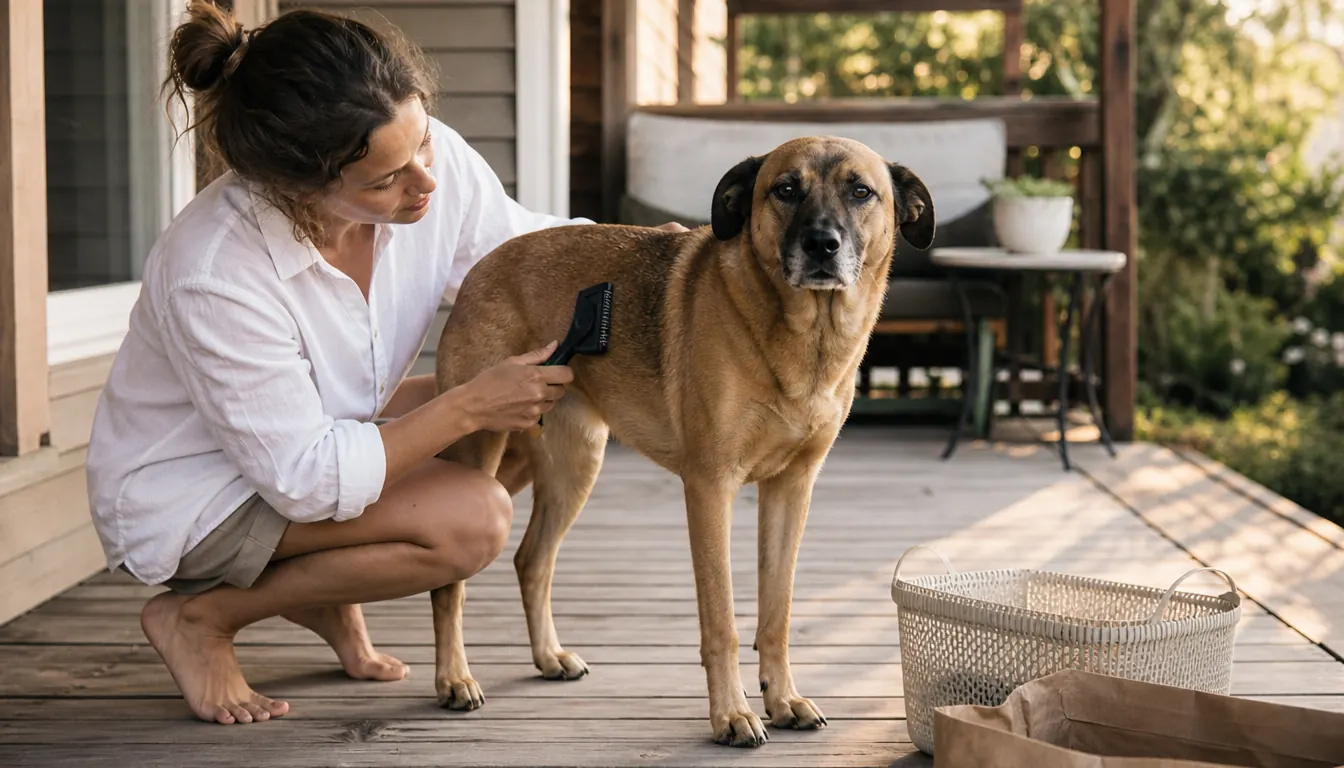
Biscuit is seven years old, mostly beagle, about thirty pounds, and he sheds like a dog twice his size. Last spring I watched a fist-sized tuft of his undercoat roll across the living room carpet, bump the baseboard, and sit there like it owned the place. Twenty minutes after I had vacuumed. That was the week I stopped pretending a weekly pass with the vacuum counted as a plan.
What I figured out over that spring is that most of the hair on my floor was already loose before it landed. It had let go of the skin days earlier and was sitting in the coat, waiting for gravity or a couch cushion to move it along. Pulling it out before it falls is easier than chasing it afterward, and it takes about ten minutes. The tool I do the pulling with is the Maxpower Planet grooming rake. Double-sided head, 17 teeth on one side and 9 on the other, stainless steel teeth, rubber handle, four ounces in the hand. I bought it last spring, it lives in a basket by the back door, and it has been in twice-a-week use on Biscuit ever since.
The rake that got to Biscuit's undercoat before the carpet did
Double-sided head: a 17-tooth side for the everyday pass and a 9-tooth side for the tight spots behind the legs. Stainless steel teeth, rubber handle, four ounces in the hand.
Amazon Check Today's Price on Amazon →Step 1: Start With a Dry Coat and a Dog Who Has Already Begun to Blow
Timing matters more than technique, at least at the beginning. A rake works by catching loose undercoat and dragging it up out of the topcoat, so if the hair is still anchored to the skin you are just combing a dog for no reason. The two or three weeks when Biscuit starts to blow his coat in the spring are the weeks the tool earns its place on the porch. The rest of the year it is maintenance, and maintenance is a much shorter session.
The first spring I had him, I bought a slicker brush, because that is what the wall at the pet store is made of. It smoothed the top of his coat and made him look presentable for about four hours. It did nothing at all about the hair on the stairs, because a slicker works on the surface and the hair causing me trouble was underneath it. Then I tried brushing him straight out of the bath, which was worse. Wet undercoat clumps and mats, and the brush skated over the top of it. Dry coat, loose hair, teeth that reach under the topcoat. That is the whole trick.
Practically: do it dry. Not right after a bath, not on a damp coat, not in the ten minutes after the dog has been in the creek. Wet hair clumps together and the teeth slide over it instead of catching it. I work on Biscuit on the back porch in the morning, when the light is good and he already thinks he is outside for his own reasons. A dog who believes he is being taken somewhere is a much easier customer than a dog who was called in from the yard specifically for this.
There is also a false start to watch for. If you rake for two minutes and come up with almost nothing, the coat is not ready. Wait a week and try again, and do not decide the tool does not work. If the head comes up fat with loose fluff on the very first stroke, you have hit it right, and you should keep going while it lasts. Those windows are short. Mine run about three weeks in spring and a lighter one in fall, and the rest of the year the head comes up half full at best.
Step 2: Work in Sections With One Flat Hand on the Dog
Biscuit is thirty pounds and does not love being brushed, so the whole session is built around him standing still for ten or fifteen minutes. That means sections, and it means keeping one hand busy.
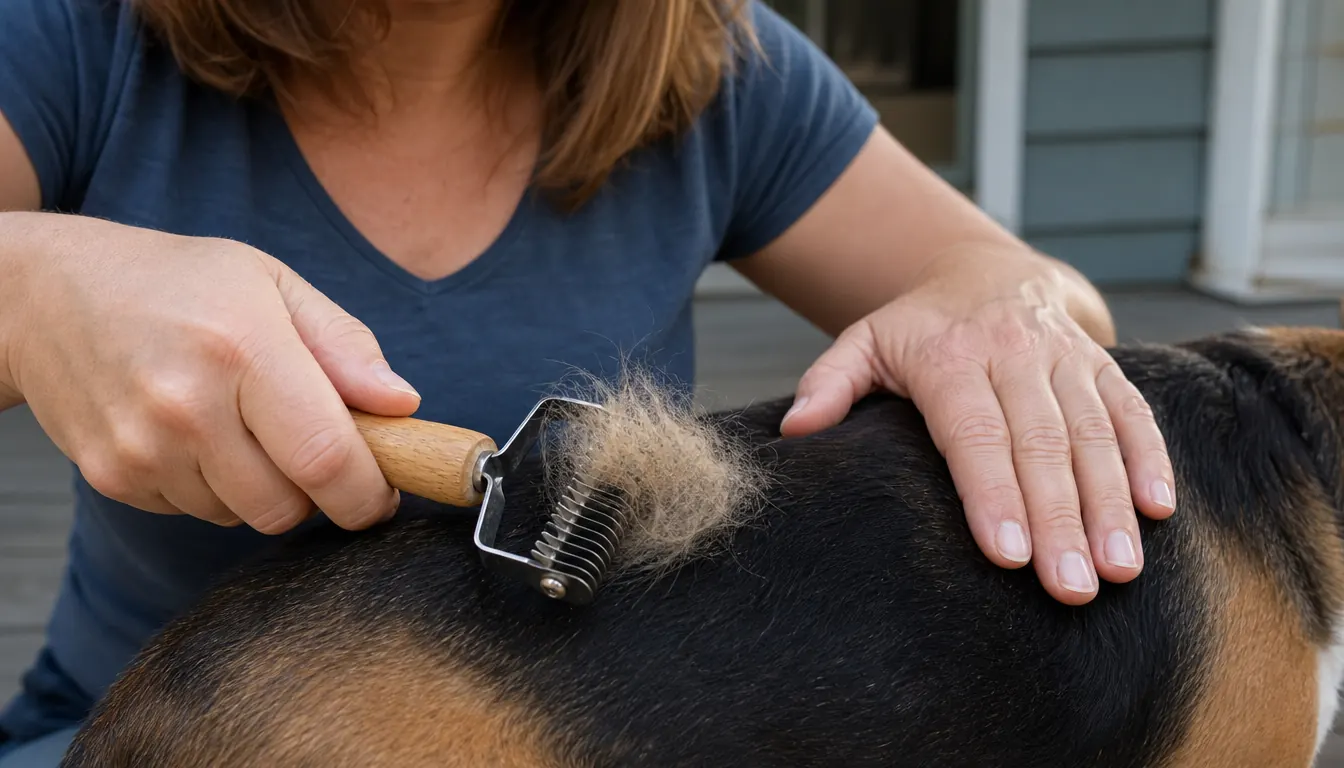
Lay your free hand flat on the dog's side, just ahead of where you are working, and keep a little tension in the skin. Not a grip. Just enough that the rake is pulling against your hand instead of against a dog who is slowly walking away from it. Then work from the shoulders back, in strips about as wide as the head of the rake, which on this one is a little under four inches across. Short strokes, maybe six inches long, lifted slightly at the end. Long sweeping pulls drag and pack the teeth, and they are also how you end up scraping a dog who has decided to lie down halfway through.
The order I use: shoulders and back first, then down both sides, then the rump and the britches, then the tail, and the legs and the area behind the ears last. Legs go last because that is where Biscuit is most likely to decide the session is finished, and I would rather get the big sections done before he makes that call. I keep an old towel on the porch boards so the hair lands on something I can fold up and shake out over the yard, instead of sweeping the whole porch twice.
Step 3: Use the Wide Side First and the Narrow Side Only Where You Need It
The Maxpower Planet rake has two sides. The wide side carries 17 teeth and the narrow side carries 9. For ordinary deshedding on a dog with no mats in his coat, the 17-tooth side does nearly all the work. It covers more coat per stroke, and the teeth are spaced far enough apart that the hair comes off instead of packing in between them.
The 9-tooth side is for the places where undercoat has packed into something denser than loose fluff. Behind the front legs, the britches, the base of the tail. On both sides the teeth are stainless steel, sharpened but rounded at the tips, which is the reason this works without scraping him raw. Where there is a genuine knot, work the narrow side in short strokes from the outside of the knot inward. Do not try to yank straight through the middle of it.
Be honest about what you are looking at underneath. If the skin is pink and angry, or there is a rash, a scab or a raw patch, put the rake down and leave that area alone until it heals. The rake is for hair. Skin is not its job, and no grooming tool fixes a skin problem.
Step 4: Keep the Passes Short and Stop Before the Coat Looks Empty
Ten to fifteen minutes is my limit, and it is Biscuit's limit too. Twice a week during the heavy shed, once a week the rest of the year. That is plenty. You are not trying to get every hair today. You are trying to get most of the loose ones off him before they land on the carpet, and you will be back out there in three days.
A good sign you are done: the rake starts coming up nearly clean. A bad sign: the dog has gone stiff, or is leaning away from your hand, or the skin along the path you have been working looks red. Stop on the bad sign. You can always do a little more tomorrow, and it is much harder to undo a dog who has decided the rake is a bad thing.
I overdid it once, in the first month, because the hair kept coming and I kept going. He was fine. But he was done with me for two days afterward, and I had to bribe him back onto the porch with a piece of cheese. It took a week of short, boring, cheese-assisted sessions to get him standing still again. That is a foolish thing to trade away over ten extra minutes on a Tuesday.
The other thing I stopped doing was saving it all for one long weekend session. Ninety minutes on a Saturday sounds efficient and is not. He gets tired of it in ten, I get impatient, and neither of us does a good job. Two short passes during the week plus one on the weekend moves more hair than one marathon, and nobody has a bad time.
Step 5: Empty the Head as You Go and Put the Rake Where You Will See It
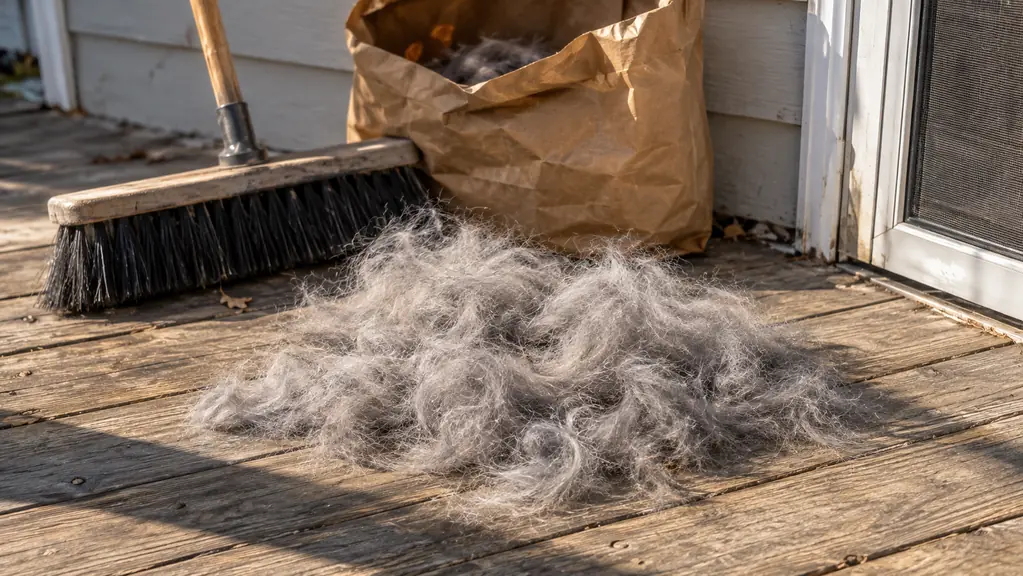
The head fills up faster than you expect. Every couple of minutes, pull the pad of hair off the teeth with your fingers and drop it straight into a bag. Do not shake it out over the porch rail, and do not blow on it. Loose undercoat is light and it travels. On shedding days I clip a grocery bag to the porch rail before I start, and that one habit cut the amount of hair I was re-vacuuming off the porch floor.
When the session is over, wipe the head down and pick out anything wedged between the teeth. Every few sessions I wash it in the kitchen sink with dish soap and let it air dry. It is four ounces with a rubber handle, so it is not a fussy object, but hair packed down at the base of the teeth makes the whole thing drag and stop catching.
Then it goes back in the basket by the back door, which is the only reason I use it as often as I do. A tool in a drawer is a tool I forget about. A tool I walk past on my way to the car is a tool I pick up twice a week without thinking about it.
What Else Helps
A bath and a high-velocity dryer will blow more undercoat out of a dog in twenty minutes than a rake will manage in a month, and I do exactly one of those at the peak of the spring shed. The rake is what handles the weeks on either side of it, plus the entire rest of the year when the coat is only letting go a little at a time. If you can only do one thing, do the frequent short sessions. They are the difference between a carpet with some hair on it and a carpet with a dog-shaped shadow on it.
The rest of the house matters too. A vacuum with a decent floor head does more for carpet than any handheld tool, and a rubber-edged roller kept on the end table handles the couch cushions and Glen's recliner between vacuums. The Maxpower Planet rake is not a replacement for any of that. It just means the vacuum has less to find.
One more thing worth knowing, because people ask me about it: a rake and a slicker brush do different jobs and you will want both eventually. A slicker finishes a coat and smooths the top layer. A rake empties the undercoat, which is the part that ends up on your stairs. If you have a short-coated cat, skip the rake entirely. I tried it gently on Juniper a few times and she tolerates about two minutes before she is finished with the whole conversation, which is fine, because she does not need it.
The hair was already loose. The rake just got to it before the carpet did.
Ten minutes on the porch beats an hour behind the vacuum
Double-sided stainless steel teeth, rubber handle, four ounces. The tool that has lived in a basket by my back door for most of this year, used twice a week on a thirty-pound dog who sheds like a much larger one.
Amazon Check Today's Price on Amazon →